Driving digitalization, reducing costs and protecting the environment at the same time: Are companies facing an unsolvable problem? Read how you can tackle these three challenges at the same time with Green IT.
Table of contents:
- What is Green IT?
- Why is Green IT important?
- Green IT: measures and examples
- Green IT with GetMyInvoices
The most important answers to Green IT at a glance:
Green IT stipulates that we produce and use information and communication technology in such a way that it does not pollute the environment. The concept originated in 1992, when the US Environmental Protection Agency invented the Energy Star environmental label.
Information and communication technology consumes more and more electricity. If we continue to increase our electricity consumption, IT will become a climate threat.
In order to implement Green IT in practice, companies need a coordinated and digitalized IT infrastructure. These include, among other things, energy-efficient devices, a paperless office and modern work structures.
GetMyInvoices digitizes invoice management. This saves companies paper, files, foil and paper clips. In this way, companies save costs and protect the environment.
Digitizing processes and integrating environmental protection into our everyday lives: These two topics concern not only politics and society, but also you as the owner or managing director of a company. Because: Digitality is considered an efficient way to keep our planet alive and habitable for future generations. In order to achieve this, Green IT has become the focus of companies in information technology. We explain how you can use Green IT to not only protect the environment, but also reduce costs for your company. And: We show which Green IT measures are suitable for this.
What is Green IT?
Green IT describes the environmentally friendly use of information and communication technology products and services. This means: We should produce, use and dispose of resources, energy and materials in such a way that we have as little impact on our environment as possible.
Green IT is not an invention of today. The concept goes back to 1992, when the US Environmental Protection Agency invented the Energy Star environmental seal. This was a voluntary seal that identified IT devices with high energy efficiency. Companies should save money and reduce greenhouse gases. At the beginning of the 2000s, an awareness of Green IT developed. Because: The Internet and the associated hardware drastically increased energy and resource consumption.
Why is Green IT important?
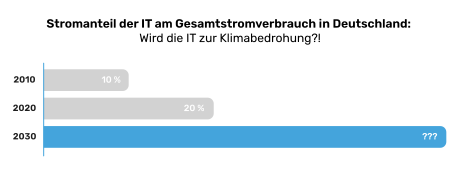
Our modern world can no longer do without information and communication technology. In 2010, IT used only ten percent of the total electricity consumption in Germany. The Federal Ministry of Economics and Technology assumes that the value was already 20 percent in 2020. If we don’t take action against it, IT will develop into a climate threat.
Green IT: Eight measures and examples
The German Energy Agency (DENA) assumes that small and medium-sized companies could save up to 75 percent energy in their IT infrastructure. So which Green IT measures can you use to protect the environment?
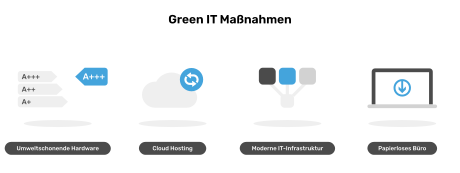
1. Use environmentally friendly hardware
Companies should make purchasing employees aware of environmental protection. They should only choose hardware that has been manufactured in a resource-saving manner, uses little energy, is durable and can be disposed of in an environmentally friendly manner. You can look out for seals relevant to Green IT such as the Blue Angel and the Swedish TCO test seal.
2. Use cloud hosting
If possible, avoid using a company-owned server. This way you have to buy less hardware. You can store your data in a cloud to save resources.
3. Build modern IT infrastructure
Virtualize and centralize your IT services. This creates a modern and coordinated IT infrastructure that corresponds to the idea of Green IT.
4. Implement a paperless office
Our work today involves complex bureaucracy and documentation. This is particularly evident in a lot of paper and plastic. Consistently advance your company paperless processes around. You can now find a large selection of green IT software such as Green Mail on the market. This way you not only save paper, but you also don’t have to buy a printer or toner.
5. Introduce mobile working
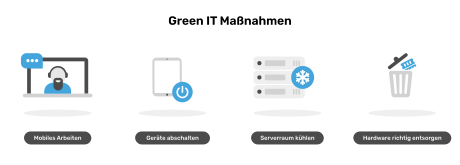
The Corona crisis has shown that many trips to the office or to meetings are unnecessary. Employees can attend appointments from home or from the company location. Therefore, make mobile working the standard in your company.
6. Turn off devices
Employees should turn off devices at the end of a workday. Power strips and timers that take unneeded devices off the power grid also help. And: With energy saving functions, you can only activate individual system components of your IT when you actually need them.
7. Cool the server room
Cooling and lighting use around 50 percent of the energy in a server room. This means: Avoid server rooms exposed to sunlight and use windows with reflective films and insulation. And: Optimize the air flows in the server room.
8. Dispose of hardware correctly
An exemplary Green IT example is the correct disposal of computers and other IT hardware. If possible, you should recycle and reuse individual parts.