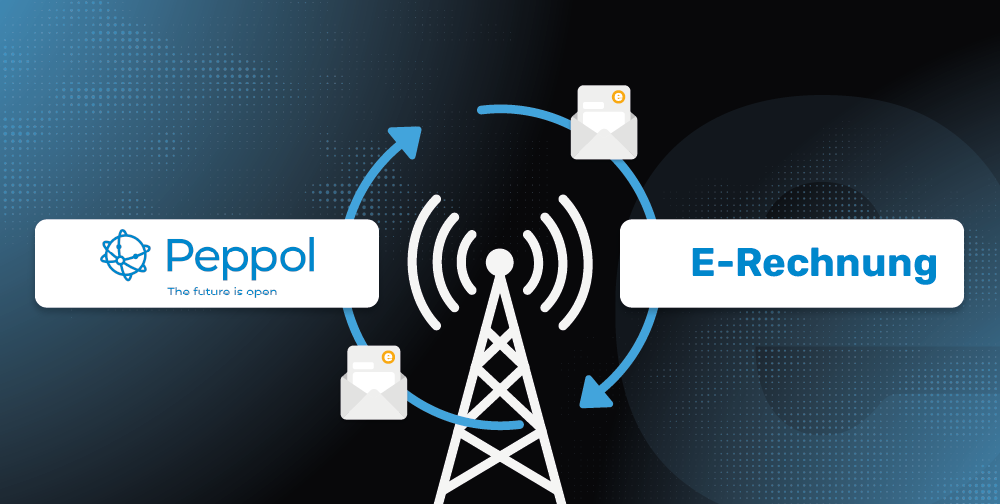
Peppol invoice receipt is the automated reception of structured e-invoices via the Peppol network. The invoice is securely and encryptedly delivered from the sender to the recipient via certified access points and is then available there as a machine-readable data record for further processing.
The mandatory use of e-invoicing changes how invoices arrive at your company. Peppol is the European standard for the secure, automated, and machine-readable delivery of e-invoices.
For companies, this means less manual data entry, audit-proof transfer, and a clean transition into their accounting system.
Table of contents
- This is how Peppol’s invoice receipt process works technically.
- What role does the access point play?
- Formats received via Peppol
- Requirements for Peppol invoice receipt
- Peppol invoice receipt with GetMyInvoices in practice
1. This is how Peppol’s invoice receipt process works technically.
Receiving an e-invoice via Peppol follows a standardized transmission path involving four parties. This model is known as the 4-Corner Model and forms the foundation of the entire Peppol network.
The 4-Corner Model in Four Steps
Step 1
The invoice issuer (Corner 1) creates the e-invoice in his own accounting or
invoicing software and submits it to his access
point.
Step 2
The transmitter’s access point (Corner 2) verschlüsselt und signiert das Dokument und
übermittelt es über das Peppol-Netzwerk an den
zuständigen Access Point des Empfängers.
Step 3
The receiver's access point (Corner 3) prüft die technische Zustellbarkeit, validiert die
Rechnung gegen die Peppol-Konformitätsregeln und
bestätigt den Empfang.
Step 4
The receiver's target system (Corner
4) receives the verified invoice as a structured data
set and makes it available for further processing,
such as approval, booking or archiving.
Communication between the access points uses the AS4 protocol, an internationally standardized transmission method with encryption, digital signature, and delivery confirmation. Attempts to manipulate the invoice data during transmission are detected by the digital signature and result in the message being rejected.
2. What role does the access point play?
The access point is the central technical component in the Peppol network. Without it, neither sending nor receiving e-invoices is possible.
What an access point does
An access point is a certified service provider that establishes access to the Peppol network and secures the transmission between sender and receiver. It handles encryption, signing, validation against the Peppol specification, and delivery confirmation according to the AS4 protocol.
Each access point undergoes certification by Peppol and is subject to ongoing testing. Germany The Coordination Office for IT Standards (KoSIT), acting on behalf of the IT Planning Council, assumes the role of the Peppol Authority and accredits access point providers operating in Germany.
Do companies need their own access point?
No. A dedicated access point is neither necessary nor economically viable for businesses. Peppol functions similarly to a mobile network. You need a provider to participate, but you don’t build your own infrastructure.
In practice, network access is handled via software or specialized service providers that already operate as certified access points or collaborate with such providers. fino data services GmbH, the operator of GetMyinvoices, is a certified Peppol Service Provider; the technical aspects run entirely in the background. You don’t need to worry about certification or format negotiation.
3. Formats received via Peppol
The Peppol network exclusively transmits structured, machine-readable invoices. In Germany, these are typically invoices in the XRechnung format or the hybrid ZUGFeRD format (version 2.0 and later). Both comply with the European standard EN 16931, which defines mandatory fields, data structure, and validation rules for e-invoices.
Pure PDF invoices are not delivered via Peppol because they do not meet the requirements for a structured e-invoice. We explain the technical differences between the permitted formats and which one is suitable for which use case in the article. „“What’s behind EN 16931? XRechnung and ZUGFeRD explained for SMEs”“ .
What happens if an invoice sent via Peppol cannot be validated?
What happens if an invoice sent via Peppol cannot be validated?
Validation within the Peppol network takes place in two stages: first at the sender’s access point, then at the recipient’s access point. If an invoice fails one of these checks, for example, because mandatory fields are missing or the EN 16931 standard is violated, delivery is rejected and the sender receives structured feedback detailing the specific error.
A formally incorrect invoice will therefore not even reach you as the recipient, and the sender will be informed. The content review of the invoice, such as the plausibility of the amounts or their consistency with your order, is carried out independently in your accounting department.
4. Prerequisites for Peppol invoice receipt
In order to receive e-invoices via Peppol, three conditions must be met.
1. Peppol ID as a mandatory address
Every receiving company needs a unique Peppol ID, which serves as its address within the network. Without this ID, no invoice can be delivered because routing is based on the ID. We explain how a Peppol ID is structured and its function within the network in the article. „“What is Peppol?”.
Do we need our own Peppol ID or is the one from our service provider sufficient?
You need your own Peppol ID for your company. This ID serves as a unique address within the network and is assigned to your company, not the service provider. This is comparable to your telephone number, which you need to be reachable by phone. The application is submitted through your software provider. In Germany, the Peppol ID is usually linked to your VAT identification number or another unique company identifier such as the GEBA, VAT ID number, GLN, or IBAN.
2. Connection via suitable software
You need software that connects to the Peppol network. This software handles communication with the access point, receives invoices, and integrates them into your workflow. You do not need to set up your own technical connection to the network.
3. Processing structured XML data
An invoice delivered via Peppol arrives as an XML data set, not as a visually readable document. Your software must be able to process, validate, and prepare this data for display or further processing. This guarantees fully automated processing without manual data entry or error-prone extraction. The hybrid ZUGFeRD format also includes an embedded PDF view component, while the XRechnung format does not.
Is Peppol invoice receipt mandatory for the German e-invoicing obligation?
No. German e-invoicing regulations stipulate structured formats according to EN 16931, but do not prescribe a mandatory transmission method. Peppol is a recommended and particularly secure option; sending via email with an XML attachment is also permitted. (With the EU initiative…) ViDA With the planned reporting obligation from July 2030, Peppol is gaining significant importance as a standardized transmission method.
5. Peppol invoice receipt with GetMyInvoices in practice
GetMyInvoices handles the entire incoming invoice process, from receipt and validation to handover to your accounting department.
Incoming Peppol invoices are automatically received, validated against the requirements of the EN 16931 standard and merged with all other incoming invoices in your document management system.
Can we continue to receive e-invoices via email alongside Peppol?
Yes. Peppol doesn’t replace email, but rather complements it as an additional input channel. Whether an invoice originates via Peppol, email, or one of the over 10,000 connected online portals is irrelevant to the subsequent workflow. All invoices go through the same approval, review, and archiving process.
The verified data is then automatically transferred to your accounting or tax advisor software. GetMyInvoices supports DATEV, Lexware Office, sevdesk, and other common solutions via native interfaces.
How do I communicate our Peppol ID to suppliers?
Include your Peppol ID in your email signature, on orders, and on your website. The more suppliers know your ID, the higher the percentage of automated invoices will be.
Conclusion
Peppol’s invoice processing system is technically sophisticated, yet doesn’t need to be complicated in day-to-day operations. Users who opt for software that integrates connectivity, validation, and further processing will hardly notice the underlying infrastructure.
Manual document entry is reduced; an automated and quality-assured process creates the basis for clean and audit-proof accounting.
Preparing early for the transition from manual invoice processing to a structured, automated invoicing system saves time and reduces potential errors. GetMyInvoices supports this transition from applying for a Peppol ID to transferring the data to your accounting department.