The federal government has provided further financial resources as bridging aid for self-employed people, freelancers and smaller companies that are still suffering from the economic consequences of the corona pandemic. In order to get the money in time, you have to be quick: the deadline is June 15th. away!
Table of contents:
- Bridging aid 2022
- What does bridging aid cover?
- Who can use bridging aid?
- Conditions for bridging aid
- Attention: Different application procedures
- Don’t miss the deadline!
After the big waves of the pandemic, life is only slowly returning to normal. Many (smaller) companies, but especially freelancers and self-employed people, are still feeling the economic consequences very directly. Sales are missing or are lower because demand has collapsed or orders that have already been confirmed have been canceled.
The events industry is particularly affected because exhibitions, celebrations, congresses and other events could not be held at all or at least not economically viable due to the protective measures. The fixed costs for (office) rent, insurance contributions or internet access still continue. In order to close this gap, the federal government has launched some financial programs as bridging aid.
Bridging aid 2022 – two programs
In order to help companies and the self-employed through the difficult times, the federal government is continuing its bridging aid in 2022. There are currently two programs that provide liquid funds.
- Corona bridging aid IV
- Restart assistance 2022
The goal of the Bridging aid IV The aim is to provide companies, self-employed individuals and freelancers with liquidity support if they are faced with a high loss of sales due to the Corona pandemic have to fight.
With the Restart assistance 2022 The federal government primarily supports self-employed people, cooperatives and irregular or short-term employees in the performing arts. This special program was created specifically for these groups of people because they generally have significantly lower fixed costs than other companies.
What does the bridging aid cover?
There are differences between the two aid programs in terms of the costs that are supported. For bridging aid IV, these include:
- Rents and leases for buildings, land and premises
- Other rental costs, e.g. B. for vehicles and machines
- Interest expenses for business credits and loans
- Depreciation
- Financing cost portion of leasing installments
- Expenses for necessary maintenance and servicing of things that are part of the company’s assets
- Expenses for electricity, water, heating, cleaning
- Property taxes
- Operating license fees
- Insurance, subscriptions and other fixed business expenses
- Costs for auditing third parties such as tax advisors
- Personnel expenses
- Marketing and advertising costs
- Spending on hygiene measures
Based on this (incomplete) list, it is already apparent that these types of costs hardly occur for many self-employed people. You often do your bookkeeping alone, so you don’t have to pay any costs a tax advisor. The study in the apartment is often the focus of their activities, so there are no major rental or lease costs. That’s why the restart aid 2022 was initiated. With this bridging aid, there are no requirements regarding the use of the grant. The recipients can therefore freely use the restart aid.
Who benefits from the bridging aid?
The legislature has defined precisely who can apply for bridging aid. Bridging aid IV is granted upon application:
- Companies with a global turnover of up to 750 million euros in 2020
- Solo self-employed and self-employed members of the liberal professions
- Companies in the pyrotechnics industry, wholesale trade and the travel industry even if they achieved sales of more than 750 million euros in 2020.
- Non-profit organizations
The following may apply for restart assistance:
- Solo self-employed people
- One-person corporations
- Multi-person corporation
- Cooperatives
Both programs exclude people or companies that were already in economic difficulty as of December 31, 2019.
Bridging aid depends on conditions
Whether bridging aid is paid and its amount depends on specific requirements. The requirements are described in detail in the legal conditions. In a nutshell, eligibility depends on two basic factors.
- The sales must have arisen due to the pandemic or the protective measures (business closures, event bans, etc.). This must be justified in the application. This excludes declines in sales caused by other events.
- In addition, sales must have fallen significantly compared to the comparable period.
In the case of Bridging Aid IV, “significant” means that there has been a corona-related decline in sales of at least 30 percent compared to the comparable month in 2019. The situation is similar with the restart aid.
If bridging aid is granted, a monthly advance payment of the eligible costs will be made as part of Bridging Aid IV.
This is a little different when it comes to restart assistance. There is a one-off payment of 50 percent of the three-month reference turnover, but a maximum of 4,500 euros per quarter for self-employed people and one-person corporations.
Beware of possible repayments!
What is important, however, is that in both cases it is an advance payment. At the end of the respective funding period there is a final statement.
It may be the case that the funding has to be repaid proportionately. If actual sales were more than 90 percent before the pandemic, the restart aid must be repaid in full. If the turnover is a maximum of 40 percent of the reference turnover, the advance can be kept. For sales between the two limits, a pro-rata refund will be made.
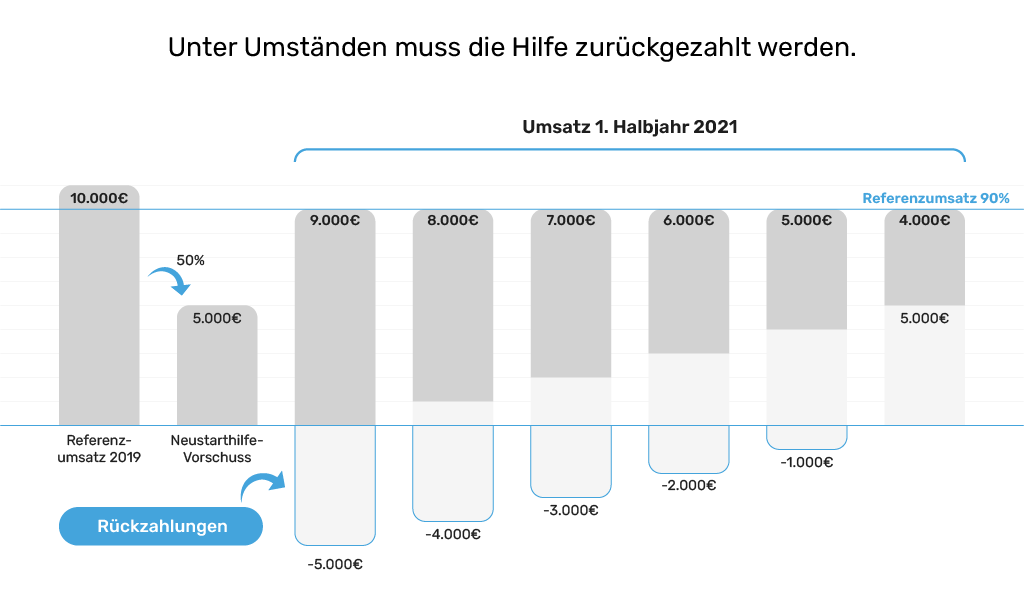
It would go beyond the scope of this article to go into further detail. For example, the legislature has regulated exactly how the reference turnover is to be calculated if the company was founded during the pandemic.
Attention: Different application procedures
An application must be submitted to receive the subsidy. The path here also differs depending on the program you choose.
Application for bridging aid IV
The application for bridging aid IV must be submitted by “verifying third parties” on behalf of the company or entrepreneur. This group of people includes tax advisors, tax agents, auditors, lawyers and sworn auditors. They will also request and view the necessary documents and calculations.
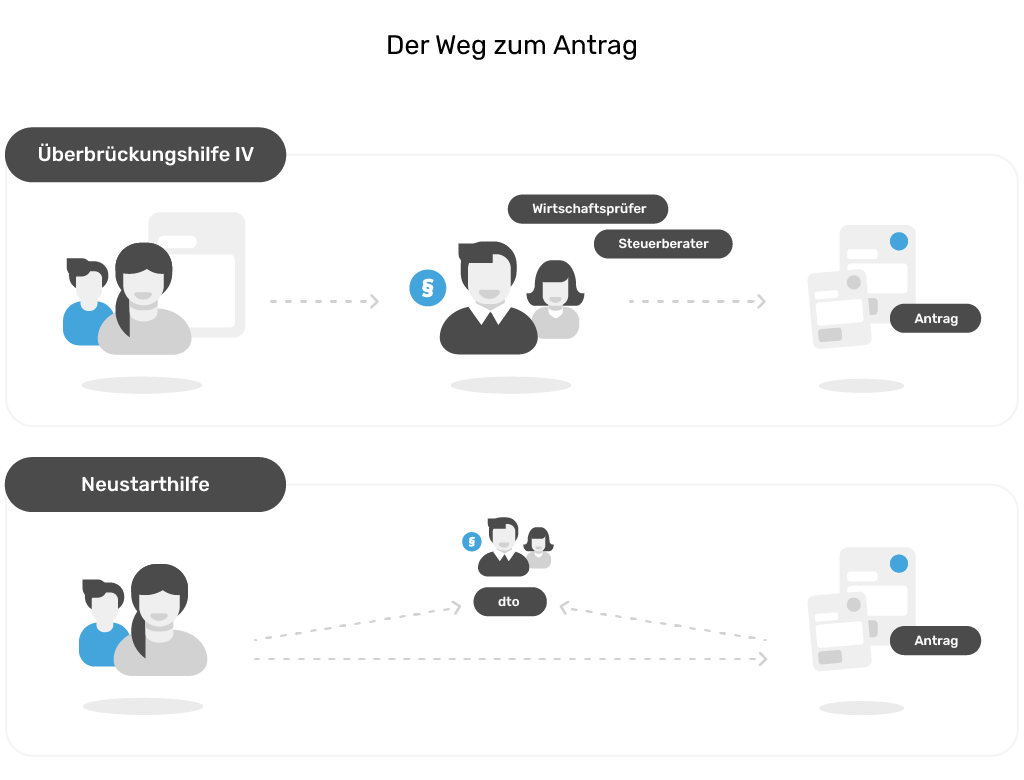
Application for restart assistance
This also applies to restart assistance if the application is submitted by a legal entity, such as a corporation. Natural persons, i.e. self-employed people and freelancers, can also apply for restart aid directly. However, you are free to involve a third party to check. This may also be a better choice because professionals will likely be able to calculate reference sales more quickly and easily.
Pay attention to the deadlines and act now
If you want to secure bridging aid, you have to hurry up with the application now, because there are important deadlines:
- Bridging aid IV can only be applied for until June 15, 2022 (this applies to initial and amendment applications).
- New applications for restart assistance can also only be submitted until June 15, 2022.
June 15th is also the deadline for all self-employed people and freelancers who have already applied for bridging aid IV or who have been granted the aid but who would rather use the restart aid. Because they are given the right to vote.
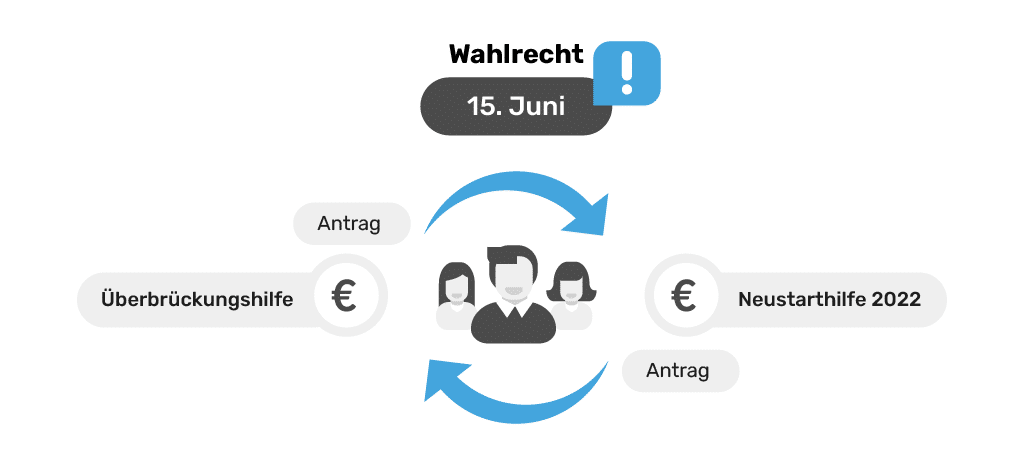
The change is made with an application for the program to which you want to change. Reference must then be made to the already successful application from the other program.