What if? Founders probably ask themselves this question more often than they would like. Ultimately, business decisions should always be well thought out and analyzed. Read here how opportunity costs can help you make the best possible decision.
Table of contents:
- What is opportunity cost?
- The opportunity cost principle
- Opportunity cost examples
- Calculate opportunity costs
All the important answers to the topic of opportunity costs at a glance:
Opportunity costs are hypothetical costs of an alternative course of action not chosen. They always arise when you choose between two options and are therefore also referred to as waiver costs.
If you become self-employed and give up your current permanent position, your opportunity costs will correspond to the amount of lost wages you lose.
Opportunity costs always arise when you choose between two alternative courses of action. If you choose option A instead of option B, you forego at least one option.
As is well known, anyone who has a choice is also spoiled for choice. And just like in your private life, you always have to choose between different options in your everyday business life. It starts with that Starting a business to: Should you start a business or stay in a permanent position? Is the product offered economical or is it worth offering another one? And is it really worth it, you? Equity capital to invest in your company? All of these decisions incur opportunity costs.
Determining opportunity cost is a vastly underestimated strategy for weighing the economic advantages and disadvantages of different options. They are particularly important for founders and entrepreneurs. Because they help to make the best possible use of limited resources and provide information on important questions related to the company’s success.
What is opportunity cost?
The term opportunity comes from the English noun “opportunity” and in German means something like “possibility” or “expediency”. Opportunitätskosten sind demnach Kosten, die entstehen, wenn Sie auf eine von zwei Möglichkeiten beziehungsweise Alternativen verzichten.
Sie sind nicht zu vergleichen mit regulären Cost and therefore don’t really have to be paid for. Rather, the opportunity cost depresses what is lost Profit oder Nutzen aus, weil Sie eine von zwei (oder mehr) Handlungsalternativen nicht wahrnehmen können.
Diesen verpassten Gewinn oder Nutzen bezeichnet man als Opportunitätskosten. Oder einfach gesagt: Opportunitätskosten sind der entgangene Nutzen einer nicht wahrgenommenen Handlungsalternative. Daher werden Opportunitätskosten auch als Verzichtskosten, Alternativkosten oder Schattenpreise bezeichnet.
The opportunity cost principle
The opportunity cost principle is a concept from economics and economics and describes how to deal with scarce resources. Especially in business, resources are limited and there are always situations in which entrepreneurs have to choose between two alternatives. But there are also countless examples of opportunity costs in everyday life. Basically, you encounter them every day!
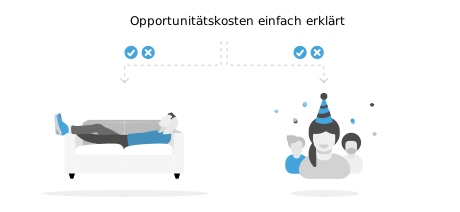
It’s Friday evening, your work week has been tiring and all you want to do is put your feet up and catch up on your well-deserved sleep. If it weren’t for the invitation to the birthday party tonight. Since your resource “time” is limited, you must choose one of the two options. If you stay at home, the opportunity cost is a disappointed circle of friends and a missed evening with your acquaintances. If you follow the invitation, you will probably spend the whole Saturday in bed – the day is “lost”.
This is how opportunity costs help you make the right decisions
Opportunitäten sind also Bestandteil unseres alltäglichen Lebens. Wichtig ist nur, dass Sie die richtige Entscheidung treffen. Genau hier kommen die Opportunitätskosten ins Spiel.
Berücksichtigen Sie die Kosten, können Sie bessere Entscheidungen sowohl im privaten als auch im unternehmerischen Bereich treffen. Die Opportunitätskosten zeigen auf, welche Chancen, Risiken, Verluste oder Gewinne die Entscheidung für Option eins im Vergleich zur zweiten Option haben kann. So können Sie die Möglichkeit wählen, die am wenigsten Ressourcen verbraucht – also die geringsten Opportunitätskosten hat.
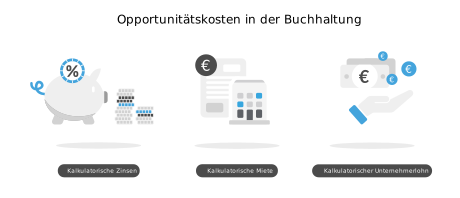
Im betriebswirtschaftlichen Alltag werden die Opportunitätskosten daher in der Kostenrechnung als kalkulatorische Kosten berücksichtigt.
Calculated costs, in turn, refer to costs that either involve no effort at all (so-called additional costs) or an equally high amount of effort (so-called other costs). Examples are imputed interest, imputed rent or imputed entrepreneurial wages.
Opportunity cost examples
The importance of opportunity costs for your company is best explained with practical examples.
Example opportunity costs: changing jobs or starting a business
You decide to concentrate fully on your start-up and give up your current part-time job. After a year of self-employment, take stock: In the first year of setting up your business, you were already able to make a profit of 10,000 euros. Not bad to start with, right? If it weren’t for the opportunity costs. In your part-time job you earned 20,000 euros per year. The salary you lost by starting your business is now considered an opportunity cost. Your actual profit is therefore minus 10,000 euros.
Example opportunity cost: rental income
Let’s assume you own a property and can use the space directly as an office. However, you also have the option of renting out this space and generating rental income. For example, if your property is in a sought-after area with a high rent index, renting it out could be more profitable than using the rooms for your own use. The lost profits of the hypothetical rental income compared to the actual owner-occupation are your opportunity costs.
Example opportunity costs: use of equity capital
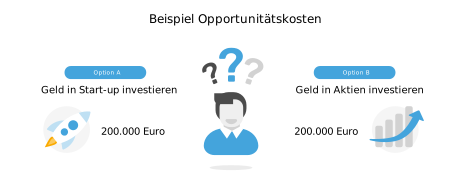
You invest 200,000 euros in equity in the start-up you founded. The dilemma: By tying up your capital, you can no longer invest it elsewhere to generate profits or interest.
Da also mit der Investition keine Zinsen anfallen, wird dieses Eigenkapital auch nicht als Zinsaufwand verbucht. Hypothetisch fallen jedoch sehr wohl Kosten an. Denn die 200.000 Euro hätten Sie auch am Aktienmarkt anlegen können und damit wiederum eine Rendite von acht Prozent erzielt (8 Prozent von 200.000 Euro = 16.000 Euro pro Jahr).
Diesen verpassten Gewinn muss Ihr Start-up nun zusätzlich erwirtschaften, damit Ihnen keine negativen Opportunitätskosten entstehen. Und mit Hilfe eines kalkulatorischen Zinssatzes können Sie diese Opportunitätskosten in Ihrer Kostenrechnung sogar berücksichtigen.
Calculate opportunity costs
A general formula for opportunity costs cannot be established, as the calculation varies depending on the individual situation. In principle, however, the following applies: the best possible alternative course of action B must be compared with the alternative course of action A. So you determine the possible costs by calculating the difference between the possible return from option A and the possible return from option B.
**Basic formula:**Opportunity cost = return from the chosen option A – return from the unchosen option B
Business significance
In der Betriebswirtschaft werden die Opportunitätskosten für betriebliche Entscheidungen genutzt. So können Sie beispielsweise über neue Aufträge oder Produkte entscheiden. Die Energie, die Sie in ein neues Projekt investieren, sorgt dafür, dass an anderer Stelle Ressourcen wie Personal, Zeit oder Geld fehlen.
Zudem können Sie die Herstellungskosten oder die Preisgestaltung auf Basis der Alternativkosten optimieren und entscheiden, ob Sie Ihr Kapital besser binden oder investieren sollten.