**The right legal form for your sole proprietorship plays a crucial role when setting up a business. Freelancer, businessman or tradesman? Suddenly there is a lot of confusion because different requirements apply to everyone. You can find out which legal form is right for you as a self-employed person here. **
Table of contents:
- Sole proprietorship legal forms
- Small business
- Registered merchants
- freelancer
- Part-time self-employed
- Sole proprietorship legal capacity
- Liability of sole proprietors
- With GetMyInvoice you can always keep an eye on your accounting
The most important answers on the topic of sole proprietorship legal form at a glance:
Sole proprietors such as registered merchants, small business owners and freelancers are liable with their entire private assets.
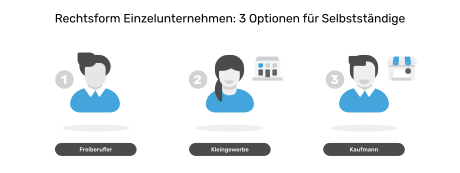
The only legal form that applies to sole proprietorship is:
- freelancer
- Small business owner
- registered merchants
The abbreviation legal form sole proprietorship is “e. U.”. The abbreviation for the legal form of registered businessman, a variant of the sole proprietorship, is “eK”.
Realizing your own business idea is an exciting one Step into independence . But before you really get started, you first have to choose the right legal form for your sole proprietorship. With so many choices, you can quickly get confused. In addition, many terms are hastily thrown together and legal jargon does not make the decision any easier. You would much rather concentrate on the exciting tasks of starting your business.
Sole proprietorship legal form – a self-employed person, many options
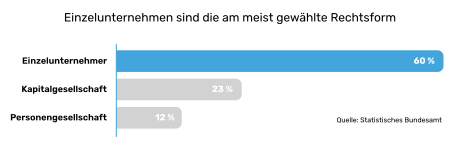
If you decide to start a sole proprietorship, you are on trend. According to that Federal office of statistics In 2020, around 60 percent of all companies in Germany were sole proprietors. This is hardly surprising, as the sole proprietorship is popular because of its simplicity.
As a self-employed person, you are either a registered businessman, a freelancer or you are setting up a business Small business . The legal form depends on your sales and your business idea.
Small business legal form – the entry-level model for starting a business
Do you have a brilliant business idea but want to start small? Then small business is probably the right choice for you! Small businesses are characterized by low sales and few or no employees.
It is very popular - after all, it is quick, inexpensive and easy to set up. You do not need an entry in the commercial register and there is no minimum capital. By registering your business with the trade office you will receive your trade license. You then register with the tax office and your small business is officially considered founded! Whether your business meets the requirements for a small business depends on your sales and is decided by the tax office.
Tax specifics of a small business
Whether you pay trade tax at the end of the year depends on the income you generate. In 2022, this only applies to annual profits of 24,500 euros or more. If you earned less in the financial year, you will not have to pay trade tax. But be careful: As the owner of a small business, you are obliged to file a tax return.
Accounting in small businesses
As a small business owner, you can breathe a sigh of relief when it comes to bookkeeping. You are only obliged to carry out simple bookkeeping, you do not have to prepare a balance sheet, you do not have to publish your annual financial statements and you do not need to take inventory.
The registered merchants (eK)
If you operate a trade in goods or services, you are considered a merchant according to Section 1 of the Commercial Code. Entry in the commercial register is mandatory. It takes place informally and without minimum capital. You can’t go past the trade office, because that’s where you can get the trade license you need.
Bookkeeping for merchants:
By entering the commercial register, you are subject to all rights and obligations of the German Commercial Code (HGB) and are therefore also obliged to double-entry bookkeeping and prepare a balance sheet.
Tax special features for registered merchants
There is also a tax peculiarity here: If your sales revenue is less than 600,000 euros and your annual surplus is less than 60,000 euros, a simple income-surplus calculation (EÜR) at the end of the year is sufficient for tax purposes.
Legal form freelancer
If you are active in art, science, writing or education, you are most likely a freelancer. A complete list of all professions can be found in Section 18 Paragraph 1 of the Income Tax Act. You can check with your local Chamber of Industry and Commerce to see whether you fall under freelance status. However, the final decision is always made by the tax office. You register your company there, receive a tax number and you’re ready to go!
Bookkeeping as a freelancer
As with all business activities, as a freelancer you are also obliged to pay taxes. They only pay attention to a simple one Accounting . You can do without a balance sheet with a clear conscience.

Special case: self-employed part-time
Starting your own business doesn’t have to be a jump into the deep end. By keeping your secure source of income, you can first put your business idea through its paces as a part-time job. You should note the following points:
- Work part-time for a maximum of 20 hours per week
- Make sure that your income does not exceed your salary
- Discuss your part-time job with your employer
The legal capacity of sole proprietors
Sooner or later, as a sole proprietor, you will hear the terms “natural person” and “legal entity”.
“Natural person” means nothing more than that you set up a sole proprietorship as a “real” person – with all your rights and obligations. You can conclude contracts, file a lawsuit in court, but also be sued personally.
This distinguishes a sole proprietorship from a “legal entity”, such as a foundation or AG. These are not “real” people. If you buy from a corporation, for example, you conclude the contract with the company, but not with the person behind the corporation. Therefore, these legal forms are only liable for the company’s assets.
How are sole proprietors liable?
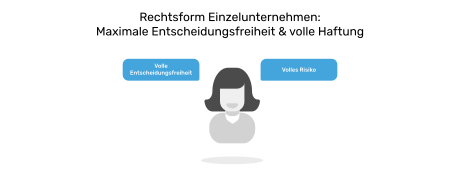
The advantages of a sole proprietorship are obvious: the company belongs only to you, you alone make decisions and you do not have to share profits with anyone. However, you bear the sole and full risk in the event of losses. If payments are not made, Reminders accumulate quickly and you may run into payment difficulties. Be aware that as a sole proprietor you are liable for all of your assets – including your private assets.
But no worry! As long as you have yours revenue and expenditure Don’t lose sight of it, you can start setting up your own business full of energy.