Freelancers enjoy some tax privileges. This also applies to the form of accounting. This guide explains how you can do your own bookkeeping as a freelancer.
Anyone who practices a freelance profession in Germany does not have to submit a comprehensive balance sheet at the end of the year. It is sufficient to fill out the EÜR attachment with your income tax return. The figures mentioned therein are the result of “simple” accounting. And because this is not always easy in individual cases, we explain what is important.
Table of contents:
A freelance profession is an independently pursued scientific, artistic, literary, teaching or educational profession. These are defined in the Income Tax Act and the Partnership Companies Act.
With simple accounting, each booking actually only exists once. A receipt is recorded either as income or as an expense. With double-entry bookkeeping (also called double-entry accounting), every business transaction is recorded twice. On one account and one offsetting account. This is also referred to as the so-called debit and credit booking.
You can also use double-entry bookkeeping as a freelancer. Many accounting programs do this internally anyway, without making document entry more complicated.
That depends on whether you have a freelance profession. If your activity is not explicitly mentioned in the laws mentioned, it is best to speak to a tax advisor and the tax office.
Tax advisors offer many services. They also help in setting up companies. In general, you should always consult a tax advisor if you are unsure about accounting. It’s better to have an expert take a look at your system before you get into trouble with the tax office. And also interesting: If you have your EÜR submitted by a tax advisor, you can submit your tax return much later.
Simple accounting at a glance
Freelancers are always allowed to use the so-called “simple accounting”. Annual sales and profits do not play a role. This form is called “simple” because it suffices to record all income and compare it with expenses. This is sometimes referred to as a “T-account,” as column division is reminiscent of the letter.
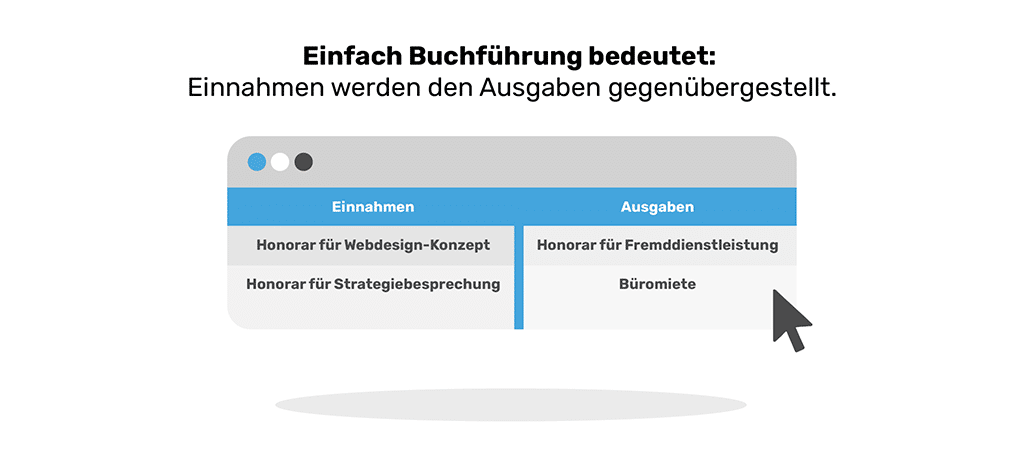
Accounting for freelancers is also easier because they are not required to keep a cash book (for cash transactions) and bank accounts are not included in the accounting.
Attention: Not all freelancers are automatically freelancers!
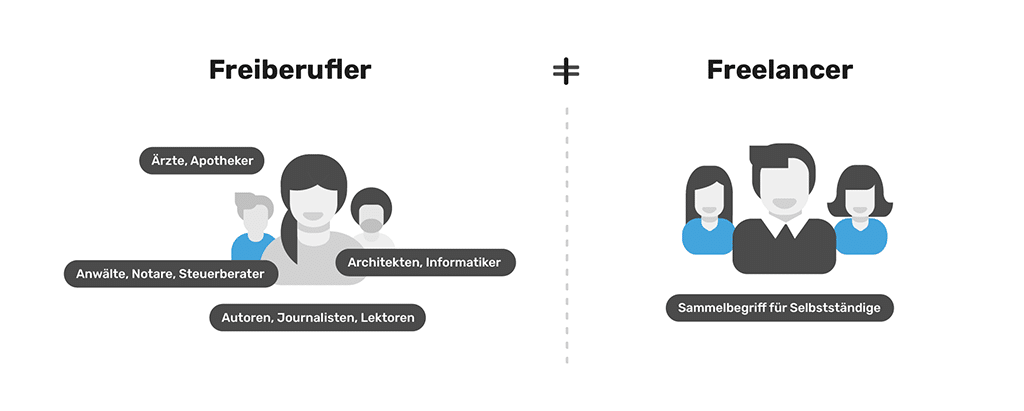
The advantages mentioned actually only apply to purely freelance work. If you are a freelancer who also runs a web shop on the side or carries out other activities, you should definitely consult a tax consultancy office. Because then different rules may apply. As a freelancer, you are not automatically a freelancer. German tax law does not even recognize the term freelancer. As a freelancer, you work freely (in the purest sense of the word this just means “freelance employee”), but you don’t necessarily fall into the category of freelance professions. They are defined in tax law. The case is very clear with journalists, doctors and architects. But there are also borderline cases. If in doubt, a tax advisor can help with the categorization. Freelancer is more of a collective term for the self-employed.
Post income and expenses in Excel
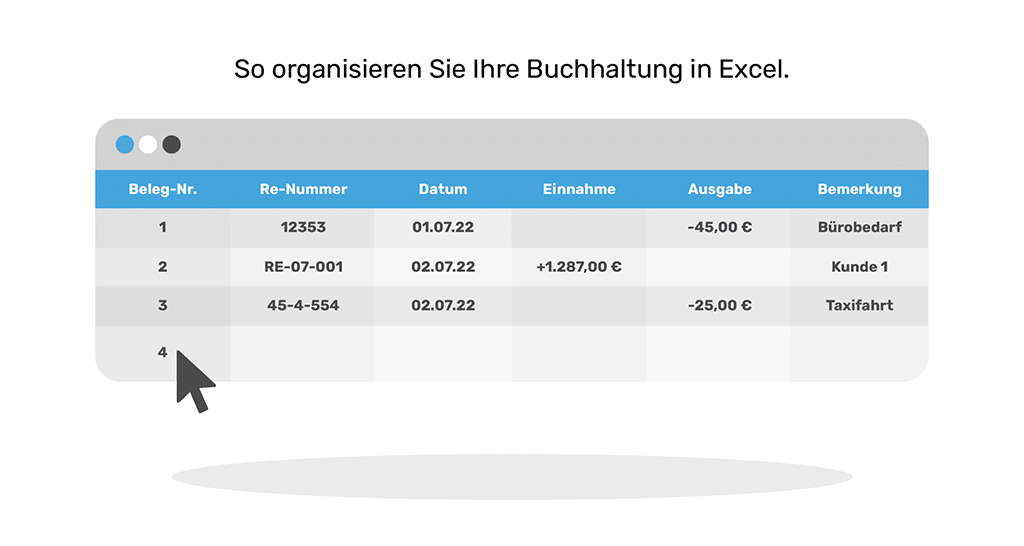
Bookkeeping based on simple accounting is actually not difficult. Accounting can even be done using Excel. But it can also be a professional accounting program. In Excel, the posting would work something like this: To make it clearer for the tax office, create a spreadsheet for each month. It then contains the columns:
- Document number: This is written or stamped on each receipt to make chronological filing easier.
- Bill number: The invoice numbers of incoming documents and the number of your outgoing invoices go here.
- Date of booking
- Revenue: Amounts in euros that you have collected.
- Expenditure: Amounts of money you have paid.
- Remark: This describes the contents of the invoice. For example, which customer it was or what you bought.
At the bottom of the worksheet, you then make the difference between the sum of the income column and the expense column.
**Important: **With this form of accounting, postings only appear once the transaction has taken place. If you wrote an invoice to a customer in January but did not pay it until March, post this invoice with the date the money was received. Once the invoice has been recorded, file it in a separate folder. It is best to do this chronologically, i.e. by date from the Excel file. Before you do this, write down the document number on the paper. However, it would be even better if you generally save all documents in digital form.
And what about sales tax and purchases?
In the example just mentioned, the topic of sales tax was not yet mentioned for a better overview. If you are subject to VAT, you must regularly send advance returns to the tax office and make advance payments. If you stick with Excel, this could be solved by dividing the income and expenses and processing the gross and net amounts. You must then reserve space on the sheet for the balance of VAT withheld and paid. Freelancers and freelancers regularly buy things to carry out their jobs. Their amounts and receipts are then recorded as expenses. But there are limits. Because only so-called “low-value assets” (GWG) are directly an expense. The legislature regularly adjusts the limit amounts for the classification as GWG. In short, this means that you can only book the acquisition costs for an item as an expense pro rata per year. The tax office defines the period very differently for different goods. This process is called depreciation. So that you (and the tax office) can keep track of everything, you need an inventory list. The depreciated (i.e. booked) amount is then deducted from the purchase value every year.
You always need a receipt!
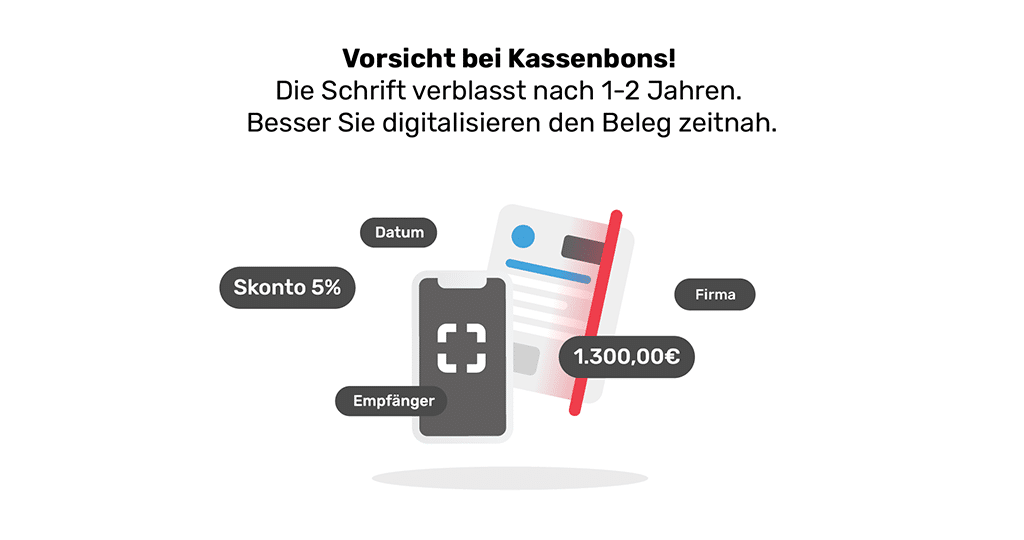
In accounting, the law “No booking without a receipt” applies. In the list of bookings, reference should always be made to the appropriate receipt as proof. For example, if a company regularly deducts amounts for insurance from its bank account, the account statement can serve as proof. Receipts and receipts can also get lost. As an exception (!), the tax office also allows “own receipts”, which have the same name. Enter the amount, the date, the intended use and the reason why there is no original (anymore). By the way, be careful with receipts. Receipt printers often work with a special paper whose thermal printing degrades over time. After a year or two, the writing has faded so much that it is no longer readable. It’s best to first make a copy of such receipts and attach the original to it. This means that the tax office can check the receipts even years later.
Retention obligations and GoBD
While individual bookings are easy to understand, legal regulations make accounting for freelancers a little more complex. A rule of thumb: You must keep all receipts relating to your freelance work for ten years. Tax officials can go back up to this period as part of an audit. So you need to think about a place where you can store the documents safely and dryly. And also take care of the digital storage. And then there is the GoBD: the “Principles for the proper management and storage of books, records and documents in electronic form as well as for data access”. You don’t have to, but you should stick to it because it makes it easier to work with the tax office during an audit.
At its core, the GoBD is based on three pillars:
- Timely recording of documents
- Timely and unchangeable posting of receipts
- Archiving of documents, unchangeable
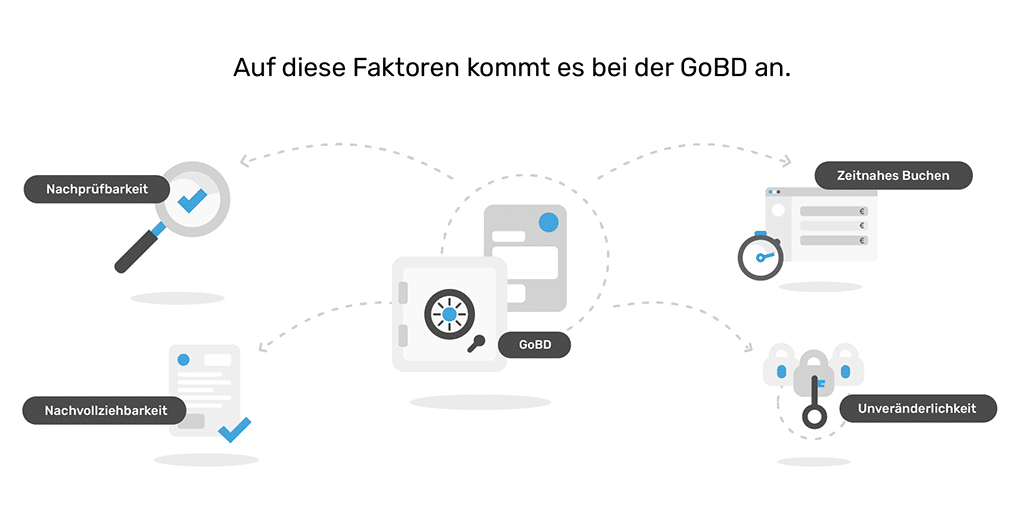
In addition, the GoBD requires that in one Procedural documentation describes how the accounting processes work. These rules apply to all companies, not just freelancers and freelancers. As a consequence, this means that every document must be archived in an unchangeable and secure manner for the duration of the retention period. And in the format in which it arrived. If an invoice is received as an email, the printout alone is not enough. The email must also be retained. And it will still be readable in ten years. The good news: The GoBD is not a legal norm, i.e. not a law. This means you will not be penalized immediately if you violate it. Nevertheless, you should stick to it if possible because the GoBD describes when accounting is comprehensible and correct. And only then will the tax office follow the figures presented. If the authority cannot understand the accounting, it can reject the entire accounting and would then estimate the profit instead. And that is usually disadvantageous for the freelancer. However, you have to solve the long-term and secure storage of bookings anyway. And that’s where software can help a lot.
Accounting software and GetMyInvoices make freelancers’ work easier
The tax office does not prescribe a specific solution that you can use to do your accounting as a freelancer. It is therefore not forbidden to do this with a spreadsheet. The compilation of sales tax or depreciation are topics that are not that easy to implement. Accounting software makes a lot of things easier.
-
- Evaluations are available at the push of a button and do not have to be built first.
- The advance VAT return can be sent to the tax office with one click of the mouse, including receipt creation.
- All bookings and receipts can be exported in the desired format for the tax office or tax consultancy office.
- Depreciation is recorded and (automatically) reposted.
The applications also ensure that no information is forgotten and that the receipts are filed properly. So the expense (annual license or monthly fee) can be worth it. Especially since the fee is of course a business expense.
Save a lot of time with GetMyInvoices
If you regularly receive invoices by email or have to visit the same portals every month to access your receipts, you can save a lot of time with GetMyInvoices. Our system carries out this task automatically and reliably. If you wish, the invoices can also end up in your accounting software. It’s best to try it out now!