No matter what situation you are currently in with your company or business, the future holds two phases in store for you.
- There will be a phase where things will go (even) better. Whatever you tackle will succeed, and you’ll probably also earn a lot of money during this time.
- But a phase will also follow where you’ll go through a crisis. Maybe it’s a crisis affecting the overall economy. But it could also just affect your industry or maybe even just your company.
You’ve probably heard the following sentence before. But because many entrepreneurs seem to keep pushing it aside, I want to give it to you again right at the start of this article:
“Crises are just as much a part of entrepreneurial life as boom phases.”
Because the economy as a whole develops in phases that repeat themselves, just like every company does.
What may sound like a worn-out phrase to you seems to sound more like a fairy tale to many companies. They believe, hope and are convinced that things will keep going upward as long as they just keep doing what they’ve been doing.
Yet it is the primary task of every entrepreneur to prepare for crisis situations during good times while also steering the further growth process “with a sense of proportion”.
But how does that work? And what should you pay attention to if you want to use your good phase for further growth while also preparing for bad times? And what does that actually mean?
That’s exactly what the following text is about.
Our goal is to build a company that can withstand crisis phases and perhaps even use them for its own growth. We can only achieve this if we’ve done our homework, because only then are we able to run our company with gut feeling and a head for numbers. Both are equally important and both are justified. Because your gut feeling makes your business unique, and your numbers keep it alive.
While you already bring the gut feeling - for example because you turned your hobby into a profession or use a special passion to solve an urgent problem for other people - you currently still struggle with the head for numbers. That’s because it’s something you normally don’t learn in any training. Even if you have a business degree, you won’t be familiar with this content in the form you need it.
Step 1: Total transparency about your financial situation
There’s no way around it - we want to know how our company is doing financially at all times. Without fog. Without hieroglyphics.
A crucial source of information here is the results report that your tax advisor provides you every month. He calls this report “BWA” and it brings together all income and expenses for the current business year and specifically the past month. The purpose of this report is to show you whether you earned more money than you spent during this period. If so, you made a profit. So far so clear. We’ll dive a bit deeper into the topic of BWA in the next section.
Once you know the profit generated in the past month, you want to compare it with your plan. Many companies forgo having a plan and argue that they simply don’t have a crystal ball, so they can’t look into the future and might as well use their time differently.
That is a mistake.
Because from more than 20 years of controlling experience, I know that when it comes to planning, it matters less to determine exact planned figures than to define measures, make assumptions, and then compare them against actual developments. “Making measurable” your entrepreneurial development becomes a gamechanger if you do it consistently, because only then will you recognize whether you’re still on track and how far you’ve already come.
You’ll also want to know your fixed costs. For this, it’s best to have an overview (Excel spreadsheet or software solution) that you update regularly. A look at your business accounts (yes, you should have several) as well as at the list of invoices still outstanding from your customers and those you still need to pay rounds off your monthly stocktaking.
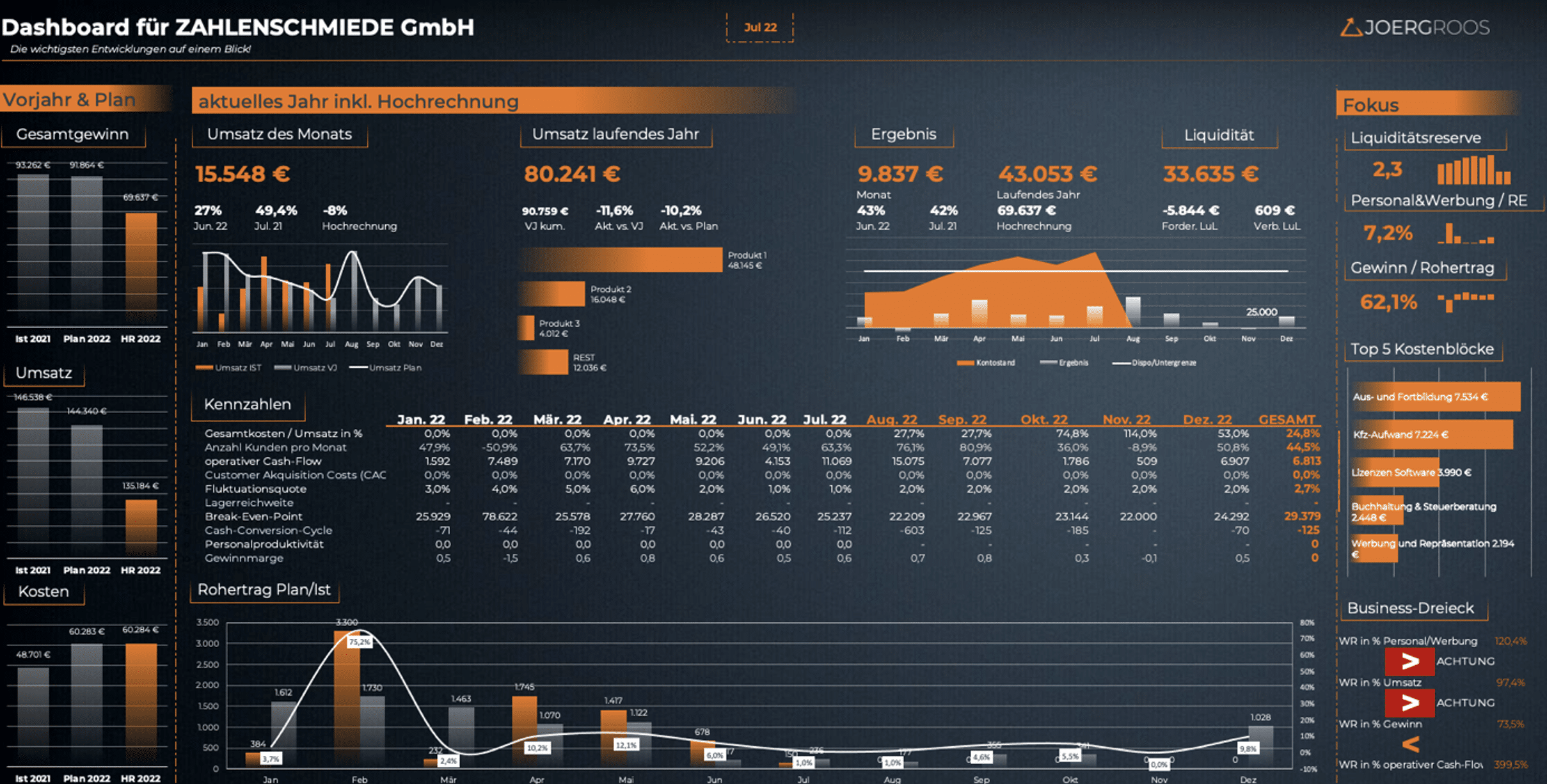
Ideally, you have a small dashboard for this where you can view all this information at a glance.
Step 2: Build a profitable day-to-day business.
Your BWA is the central source of information you want to use to measure your company’s development. Here you can read off the result with which you “closed” the past business month and the business year (yes, that’s what it’s called in business jargon). The BWA isn’t just a single report - BWA stands for Business Management Evaluations and thus represents a whole group of reports.
You can therefore look at the composition of your business success from different perspectives. This can be confusing, which is why I recommend my clients request the following three reports monthly from their tax advisor, in addition to the OPOS (open items & open balances) list:
- Prior-year comparison - to better assess the current month and the business year
- Annual overview - to more easily recognize trends and developments
- Value statement - to see the balance of each individual account
Once you have your BWA reports in front of you, the question may arise as to which figures are good or possibly bad. That’s why I want to give you two key figures that you can use as a benchmark (target value) regardless of industry and company size. To make this possible, the following key figures relate to the gross profit you generate with your day-to-day business. Because these key figures are ratio figures determined in percentages, they are also relevant for every company size.
- The sum of personnel costs and advertising costs should be a maximum of 55% of gross profit. Your business can essentially grow from two sources: your employees on one hand and advertising on the other. That’s why I call this sum growth costs, and they shouldn’t consume more than 55% of gross profit.
- The ratio of profit to gross profit should be such that the profit is at least 20%.
These two key figures mark a healthy day-to-day business and should be strived for by every company. However, to operate in the market as a financially stable company, one more ingredient is needed. Because profit, while very important, is strictly speaking only accounting theory. What matters is what actually arrives in and remains in the account.
Step 3: Build reserves that enable growth and let you sleep soundly during crises.
Through a tailored invoicing and invoice-tracking process, you want to ensure that the money generated in day-to-day business actually arrives in your business account. Even today, I far too often find that it takes too long in many companies for an invoice to be sent to customers - not to mention regular monitoring of incoming payments. Often it’s the very same companies that promptly settle their own liabilities, risking that their own account balance is much lower than it should be.
Your goal should be to build reserves and “park” them in an account kept separate from your normal business account. You might be wondering how large the reserves should be? Well, that depends on how high your mandatory costs are. These mainly consist of your fixed costs, i.e. the part of the costs underpinned by a contract and that arise regardless of your revenue.
Financially stable companies are based on a profitable day-to-day business (at least 20% return, see above) and a liquidity reserve of at least six months. That’s what I call the reserve that’s there to let you sleep soundly and act in a structured way when no (!) revenue is coming in anymore. Six months may currently seem very far removed from your current situation. That’s okay - that’s the case for most companies. Often it’s not even six weeks that especially small companies have put aside - but not least the Corona crisis has shown us all that this target value is absolutely worth striving for.
Where does your company stand when you calculate these key figures for yourself?
About the author:
Joerg Roos is the personal CFO for growing companies , i.e. your external part-time finance chief. As such, Joerg keeps your numbers under control so your business can grow at any time.