Founders would probably prefer to put all their time and energy into building their startup. But entrepreneurs also have to follow rules and laws. And for startups, that includes accounting. Our article helps you avoid traps and pitfalls.
Table of contents:
- Do it yourself or hire a tax advisor?
- Rules and regulations
- All a question of the right software?
- Separating personal and business matters
- Digitalization avoids chaos
- Save a lot of time retrieving documents!
The most important answers on accounting for startups at a glance:
The question can’t be answered in general terms. A cloud-based solution naturally has the advantage that accounting can be accessed from anywhere. It’s also easier to integrate with other services via interfaces. Cloud accounting stores all data centrally in a data center, so you don’t have to worry about data backups. A pure PC-based solution doesn’t offer these advantages. Its advantage: all data is guaranteed to stay within your own four walls.
It’s advisable to find out in advance what the accounting software covers and what requirements the startup itself has. Should invoices and quotes be created directly in the same software? Are there travel expenses that need to be settled? Should wages and salaries be booked? Most providers offer a free trial period, which you should make extensive use of.
It is an administrative regulation with which the Federal Ministry of Finance informed the tax offices about the requirements for proper bookkeeping. Tax offices base their audits on these guidelines. That’s why not only startups should comply with them.
Not automatically. Whether a balance sheet must be prepared depends on the startup’s legal form. Anyone founding a company as a member of a liberal profession doesn’t have to. In any case, it’s helpful if the accounting software supports balance sheet preparation, especially since the figures in the balance sheet are also of great interest to venture capital investors.
By selecting the services the tax advisor takes on in a targeted way. With full-service support, startups can simply hand over all receipts to the tax advisor, who then books them, handles payroll on request, and takes care of VAT and trade tax on an ongoing basis. As with building a house, you can save money with “DIY work”: for example, if you handle the bookings yourself and the tax advisor only takes care of taxes and any balance sheets at the end of each quarter and year.
Whether big or small: accounting plays an important role in every company. After all, this is where the figures for all income and expenses come together. Startups can’t take this topic seriously early enough, otherwise trouble with the tax office threatens. And that can get expensive.
Do it yourself or hire a tax advisor?
It’s typical for founders to want to keep the company’s money together as much as possible. Saving and cost control are the order of the day. Working with a tax advisor is often dismissed prematurely as an unnecessary expense. The money for an IT specialist’s or SEO expert’s advice is there, but not for the tax advisor.
Regardless of whether ongoing bookkeeping is later handled by a tax advisor, consulting with a tax advisor during the early founding phase is highly recommended. The money for this is well spent. The tax advisor helps avoid recurring and persistent mistakes.
For example, VAT is a rather complex topic. And once business relationships extend abroad, different VAT rates or the reverse-charge procedure for foreign sales can create real pitfalls that can financially trip up a startup. The tax advisor puts the company on the right track from a tax law perspective - from the legal form, to setting up the accounting, to processes for VAT, trade tax, and other levies. When choosing one, founders shouldn’t rely prematurely on Google recommendations or friends’ advice. Startups with a primarily digital business model are best served by finding a tax advisor with proven experience in this area.
Once the structures are in place, entrepreneurs can still decide whether the tax advisor should also handle ongoing bookkeeping.
Doing it yourself has the advantage that no additional costs are incurred and founders also get a good overview of all finances and business operations. Thanks to modern software solutions, bookkeeping isn’t particularly difficult either. However, correct and regular bookkeeping requires extra time - time that is then missing for core tasks.
Observe rules and regulations
“Ignorantia legis non excusat” - every first-semester law student knows this Latin formula. Ignorance is no excuse; this principle from ancient Rome applies especially in tax law.
A startup’s accounting must meet the requirements of the tax office and tax law. Deadlines for advance payments or document submissions must be strictly observed. And the entire accounting system must be set up so that it can be understood by an external third party. From the tax office’s perspective, this succeeds when companies comply with the “Principles for the proper keeping and retention of books, records, and documents in electronic form and for data access”, ****GoBD for short, .
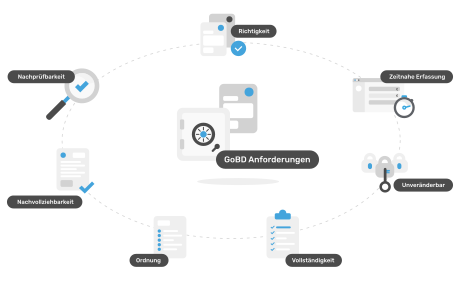
These are anything but easy reading. They deal with how receipts and documents must be stored. This is the only way to prevent changes and manipulations. In this regard, founders can give themselves some breathing room by specifically looking for software or a cloud solution that has been audited for GoBD compliance.
All a question of the right software?
Without software and digital tools, little comes together in a company’s accounting. For example, the tax office expects VAT advance returns to be submitted digitally. Anyone who chooses software that meets GoBD criteria can rely on all necessary receipts and bookings being recorded in a way that satisfies the tax office’s requirements.
But the software also has to fit the startup. If you trade goods, you should check whether you can connect inventory management to the software. The question of where and with what means invoices for (hopefully many) customers are created also needs to be clarified. Separate program or directly in the accounting software? It’s good if the software can grow along with a company’s requirements. Many cloud solutions offer numerous interfaces to external applications or can be extended with additional functions.
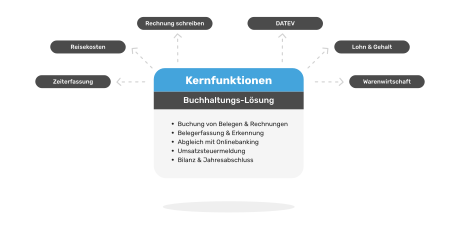
Programs often advertise a DATEV interface. Startup founders should take a closer look at this. It’s good if receipts are exported along with the individual bookings, not just the bookings themselves. After all, to check the accounting or prepare tax returns, the tax advisor also needs the supporting documents. “No bookings without receipts” is one of the unwritten principles of accounting.
Separating personal and business matters
Just as important as legal form, choice of accounting software, and notifications to the tax office or trade supervisory authority is the separation of personal and business finances. A business account at a bank is not a luxury but an absolute necessity.
This simply creates more clarity and makes it easier to provide proof of expenses and income to the tax office. A personal checking account is not suitable for this, because at a later point it becomes impossible to separate personal and business bookings. There are now many affordable business account offers from fintechs and neobanks that are also priced attractively for startups. And these account models often have direct interfaces to well-known accounting solutions.
Digitalization avoids chaos
Accounting rules require that receipts be recorded and booked as promptly as possible. The fewer manual steps required, the better. This not only saves time but also avoids chaos. And chaos can quickly break out if paper receipts are collected somewhere and nobody quite remembers what they were actually for. Receipts relevant for accounting arise in many systems and arrive in various ways. Providers usually post internet and mobile phone invoices in a customer portal. If you run an online shop, you’ll find all booking-relevant data in the shop software’s backend or in a marketplace’s seller area. Other invoices might reach the startup by email. And of course, there are still companies that simply send their invoices by mail. Accounting software should make the digitalization of receipts as easy as possible. Many solutions recognize the content automatically.
Save a lot of time retrieving documents!
You can save a lot of time retrieving and digitalizing receipts with GetMyInvoices. New receipts are simply collected from over 10,000 online portals and, if desired, automatically transferred to your cloud-based accounting system. With the scan app, receipts never end up in your wallet or in piles on your desk again - they can be digitalized immediately. Of course, in compliance with GoBD.
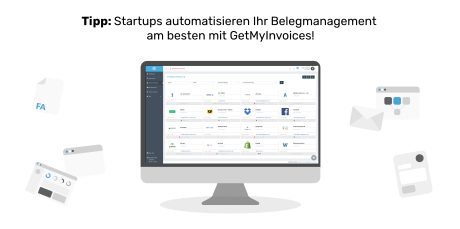
Save a lot of time with GetMyInvoices!
No matter which accounting software you use: thanks to GetMyInvoices’ interface, you can collect new receipts from over 10,000 online portals and, if desired, automatically transfer them to your cloud-based accounting system. Of course, in compliance with GoBD!
Try it now with no obligation