Every year companies have to prepare annual financial statements. This task is often associated with different requirements. All relevant positions must be recorded and deadlines must be adhered to in order to avoid tax traps. In this article you will find out how to proceed correctly when preparing the annual financial statements in order to save yourself the time-consuming task of submitting receipts and documents later.
Table of contents:
- What is a financial statement?
- Prepare annual financial statements
- What does disclosure of financial statements mean?
**What is a financial statement? **
Every entrepreneur must prepare annual financial statements at the end of a financial year. It is used to record the current financial situation of a company and thus provides conclusions about its success. It is a numerical and verbal report on the past financial year. In principle, every entrepreneur is obliged to submit annual financial statements for the commercial financial year, provided that one There is an obligation to keep double-entry books.
The annual financial statements can be divided into three main components. The profit and loss statement, the balance sheet and the cash flow statement.
Who has to prepare annual financial statements?
Look at that Commercial Code (HGB) If we take a closer look, it essentially affects the following companies:
- Corporations (AG, GmbH, UG),
- Partnerships (OHG, KG and GbR)
- as well as mixed forms (GmbH and Co. KG or AG and Co. KG)
Sole traders (eK), small business owners and freelancers can also be exempt from annual financial statements. For them, an EÜR is sufficient, which is created using simple accounting. Because a certain sales limit applies to them. You may not do more than this in two consecutive financial years** 60,000 euros profit** and no more than** 600,000 euros in sales** have earned. Then there is no obligation to submit annual financial statements.
What requirements must the annual financial statements meet?
The annual financial statements basically have two functions: information and payment measurement.
- The payment assessment function serves as the basis for the taxation of the company as well as for profit sharing, for example. B. paying dividends to shareholders counts.
- In its information function, the annual financial statements serve primarily as a planning basis for the following financial years. The results can be used by both internal and external stakeholders as a basis for decision-making. Examples include shareholders, suppliers and creditors.
What deadlines apply for the annual financial statements?
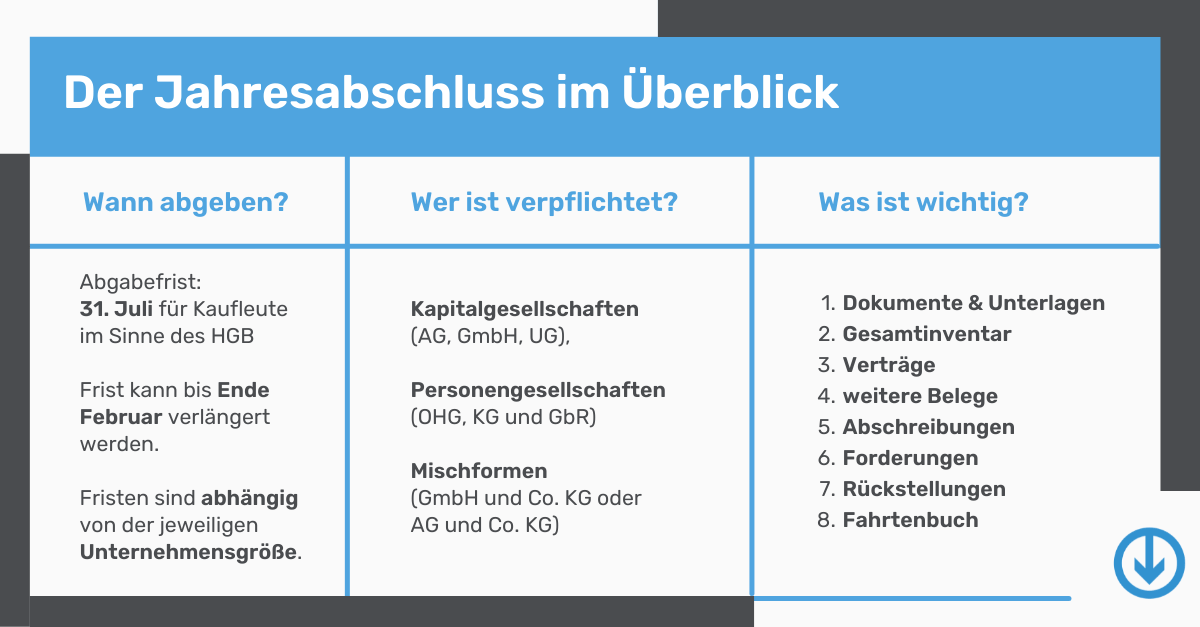
The deadline for the annual financial statements (and also for the tax return) is July 31st for merchants within the meaning of the German Commercial Code (HGB). The declarations and financial statements are now sent to the tax office in electronic form. They must be submitted to the tax office by this deadline.
An extension of the deadline is possible if a tax advisor is responsible for the annual financial statements. All others must adhere to the specified deadlines.
If it is not possible for you due to time constraints, you should definitely apply for an extension of the deadline from the tax office. As a rule, this will work without any problems End of February the following year approved.
Below we have put together the most important deadlines for annual financial statements depending on company size:
- Small and smallest GmbHs, GmbH & Co. KGs, stock corporations and other limited liability companies within the first 3 months of the current financial year for the previous financial year.
- Large and medium-sized GmbHs, GmbH & Co. KGs, stock corporations and other limited liability companies within the first 6 months.
- Registered cooperatives within the first 5 months.
As soon as the annual financial statements have been prepared - and, in the case of large and medium-sized GmbHs, GmbH & Co. KGs, stock corporations and other limited liability companies, audited by an auditor - the management must immediately present them to the shareholders’ meeting or the general meeting. It is then up to them to approve the final report and thus approve it.
**Prepare annual financial statements **
The following is sufficient to prepare annual financial statements:
- the recording of all balances
- the listing of all beginning and ending stocks in a final overview
- the final determination
These are used to record, audit and ultimately reconcile the annual financial statements.
step by step** to the annual financial statements**
In order to get to the annual financial statements step by step, the annual financial statements can be divided into the following steps.
Step 1: Gather documents and documents
It can take a lot of time to completely collect all the documents. For example, all commercial register extracts, partnership agreements as well as invoices, rental and lease agreements are required. This also includes receipts, for example for donations.
Step 2: Inventory of the company
In this step, you determine the entire inventory of the company, including all assets and debts, in order to record them in an inventory.
Step 3: Put together contracts
Another essential basis for the annual financial statements are contracts of all kinds. Insurance and credit contracts are particularly relevant here.
Step 4: Enter accounting and receipts
All accounting documents must be recorded and sorted in advance and managed correctly and comprehensibly in accordance with the principles of proper accounting (GoB). Evidence of all business transactions such as income and expenses must be taken into account here. If necessary, invoice corrections must be requested in a timely manner.
Step 5: Determine depreciation
Reductions in value must be determined and recorded as depreciation. They reduce the company’s fixed assets. Every year, machinery, company buildings, vehicles and other components of company assets lose some of their value.
Step 6: Check and record claims
Expected bad debt losses must also be taken into account. Open claims are checked here for their creditworthiness. In the event of a risk of payment default, such cases must be recorded as individual value adjustments.
Step 7: Post provisions
Companies create provisions for expenses whose amount and due date are not yet known at the time of booking. Provisions are used to record certain expenses on an accrual basis in the accounting period in which they arise (even if payment as such is made later). These include, for example, guarantees and taxes, but also impending losses.
**Step 8: Check logbook **
The logbook must also be checked. It should always be complete and up-to-date, which is particularly relevant for tax audits.
As soon as the annual financial statements are completed, they are sent digitally to the relevant tax office.
Who audits the annual financial statements?
For large and medium-sized GmbHs, GmbH & Co. KGs, stock corporations and other limited liability companies, the annual financial statements must be audited by an auditor after they have been prepared. Only audited financial statements may be established; the establishment of unaudited financial statements is ineffective.
An auditor is not required for the financial statements of small or very small companies or of companies in which a natural person as a partner has unlimited liability with his or her private assets.
The auditor must also be given a declaration of completeness by the company before starting their work. This represents the assurance of the legal representatives of the audited company about the completeness of the information and evidence provided. This ensures that
- all relevant information has been made available to the auditor,
- all business transactions recorded
- and, above all, are reflected in the conclusion.
Based on this information, the annual financial statements are then prepared - including all components required for the respective company form and size.
These include:
- balance sheet,
- profit and loss statement,
- Attachment,
- situation report,
- cash flow statement,
- Statement of equity
- as well as segment reporting on a voluntary basis.
What information must be provided in the appendix?
When it comes to the information that must be provided in the appendix to the annual financial statements according to the law, a distinction is made between mandatory information, optional information, other information and voluntary information.
Mandatory information: These may only be made in the notes (and not anywhere else in the annual financial statements). This includes the accounting and valuation methods applied to the items on the balance sheet and the profit and loss statement, including any deviations.
Elective information: This is information that must be provided, but for which the person preparing the financial statements has the choice of whether to include it in the notes or in the balance sheet or profit and loss statement.
Additional information: This refers to information that ensures that the addressee of the annual financial statements is given an actual picture of the asset, financial and earnings situation. This includes, for example, liabilities including their remaining term, the depreciation made and the burden of income and earnings tax.
Voluntary information: Voluntary information is additional information that can be provided in the appendix.
The complete list of all information to be provided in the appendix can be found in § 284 HGB and in § 285 HGB .
3. What does financial statement disclosure mean?
Certain companies have an obligation to disclose (= publish) their annual financial statements. This takes place in the Federal Gazette. This gives outsiders the opportunity to view the final report and thus obtain an overview of the company’s most important key figures. This includes, for example, profit and loss of a financial year (profit and loss statement) or assets and liabilities (balance sheet).
Which companies have to disclose their annual financial statements?
Corporations and other legal forms with limited liability, such as most GmbH & Co. KGs, must submit their annual and, if applicable, consolidated financial statements electronically to the Federal Gazette without exception.
Sole proprietors and partnerships are generally not required to publish their annual financial statements. The exception is very large companies, as this is the case with them Publicity law comes into play.
The Act on the Accounting of Certain Companies and Groups (PublG) states that a company is obliged to disclose its annual financial statements if two of the following three characteristics apply for three financial years in a row:
- On average over 5,000 employees,
- Sales revenues over 130 million euros
- as well as a balance sheet total of over 65 million euros.
Where are annual financial statements published?
Next to the Federal Gazette (Federal Ministry of Justice and Consumer Protection) the publication will also take place in Business register . The company balance sheets can be viewed online on these two pages.