Is controlling just for large companies? What tasks does controlling actually have? This article answers these questions and also explains why it is worthwhile for smaller companies and self-employed people to tackle the topic of controlling.
Table of contents:
- Controlling – what exactly is it?
- Controlling does not come from control
- Typical controlling questions
- Difference between operational and strategic controlling
- How does controlling specifically support you?
- Is controlling also possible with Excel?
- Get external help
- Controlling is also important in smaller companies
Frequently asked questions and answers about controlling
Controlling is not the same as accounting. Although there are points of contact between the two areas of responsibility, they have different objectives. Accounting records and processes business activities, while controlling deals more with planning.
One of the main goals of controlling is to ensure the sustainability of a business model and the existence of a company in the long term. It also provides important information and analysis.
Only controlling creates the basis for business decisions. Controlling provides recommendations for action that secure the existence of a company.
Large companies employ a number of employees in controlling. But what exactly is controlling? And why is it important for self-employed people and smaller companies to take care of the topic?
Controlling – what exactly is it?
Controlling is a branch of business administration. The first chairs at German universities were established at the beginning of the 1970s in order to do justice to the increasing importance of controlling in companies. As can easily be deduced from the term, controlling as we know it today comes from the Anglo-Saxon world.
Simply explained, controlling deals with the economic (key) figures of a company. The tasks include monitoring and planning the development of a company. It’s primarily about money and finances, but not only that. Controlling also deals with the use of other material and production resources and asks whether these are used correctly and sensibly.
Controlling does not come from control
When a controller appears in series and films, he will rarely seem likeable. The “bean counters” seem to contribute nothing to the success of the company and stick their noses in everywhere.
Behind the cliché is the wrong idea in Germany about the roots of the term controlling. The beginnings of the tasks actually lie more in the area of accounting and there in the checking of (open) invoices. However, the controller is not a person who only carries out controls.
Rather, it is about controlling the company (“to control”). Controlling provides figures and analyzes that point to undesirable developments. Improvements can then be made together with those responsible in other parts of the company based on these figures.
Typical questions that controlling deals with
Controlling is dedicated to questions that every self-employed person should ask themselves regularly.
- Do I have my costs under control?
- What is my operating result and how is it developing?
- Are my sales increasing?
- Can I achieve the goals I have set for myself and do they fit the business plan?
Especially in smaller companies and self-employed people, a controlling instrument is often used without being aware of it. The income surplus statement or the profit and loss statement are also important in controlling.
Difference between operational and strategic controlling
There are two major areas of controlling:
Operational controlling deals with analyzes based on quantified data. In short: everything that is based on current and measurable numbers. This then results in important key figures and instruments:
- budgeting
- Break-even analysis
- Cost accounting
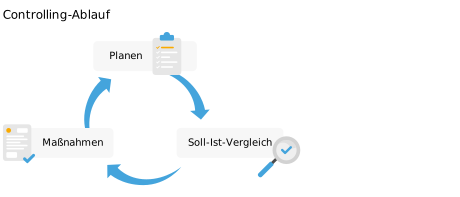
- Target/actual comparisons
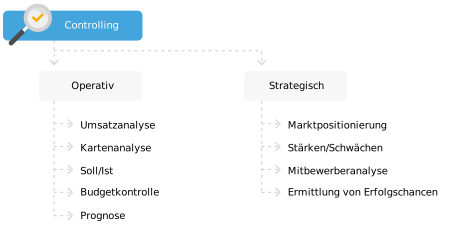
Strategic controlling cares more about qualified data and information. Numbers also play a role. However, they cannot simply be pulled from a company’s data warehouse. Strategic controlling instruments include:
- Benchmarking
- Product portfolio analysis
- strategic planning
- SWOT analysis
- Competitive analysis
Both areas are important for comprehensive controlling in a company.
How does controlling specifically support you?
In the sense that controlling also has controlling tasks, it supports companies in achieving goals. On the one hand, it provides the key figures with which the owners of a business or company can see what the company’s situation is.
Controlling also helps to motivate employees because the numbers provide information about whether their past efforts were worth it. This also makes it easier to reach target agreements. It is motivating when sales employees see that their closing rates are increasing. And recognizing that these have a downward trend makes it possible to conduct sales discussions differently in good time.
Is controlling also possible with Excel?
One of the most important tools in controlling is the spreadsheet. In most cases this should be Excel. And some warning signs that indicate possible incorrect development of the company can be easily identified using simple Excel formulas. The individual number initially says little. It must be determined regularly and then compared over time.
- Order backlog: number of orders multiplied by the processing time divided by the capacity.
- Incoming orders: Multiply the number of incoming orders by the processing time and divide by the capacity.
- Success rate of offers: Multiply the number of contracts concluded by 100 and divide by the number of offers submitted.
- Cancellation and cancellation rate: Multiply the number of cancellations or orders by 100 and divide by the total number of customers or orders.
The formulas for more complex topics and key figures such as cash flow, equity share, receivables ratios or return on assets are somewhat more complicated. If a current business analysis is available or the basic figures can be determined quickly, these values can also be calculated using Excel.
Do it yourself – or get external help?
For companies that want to implement effective cost and budget controlling, working from home offers a flexible and cost-efficient option. Controllers who want to continue their career in the home office will find a wide selection on Jooble Job offers as a budget controller in the home office . Here they can use and further develop their experience and skills in monitoring costs.
If you don’t trust yourself to do your bookkeeping yourself or simply want to save time, hire a tax firm to do it for you. Tax advisors can also take over controlling. At least as far as the basic numbers are concerned. If you need more help or want to go deeper into the development of your own company, you can also commission external service providers to carry out controlling. An investment that pays off when major changes or changes in strategy are planned.
Controlling is also important in smaller companies
Controlling in the sense of managing operations is important for every company – regardless of its size. It helps to achieve goals and points out possible problems at an early stage. That’s why self-employed people should also take the time to deal with their company’s controlling more often.