After we explained in an older article what controlling actually is, this article will focus on a specific part of controlling: cost centers and cost center accounting.
Table of contents:
- What is cost center accounting?
- Cost center accounting – how does it work?
- Introduce and implement cost center accounting
- Advantages of cost center accounting
- Cost center accounting is also worthwhile in smaller companies
Frequently asked questions about cost center accounting in controlling
The classic cost centers include a breakdown of costs into the areas of materials, production, administration and sales, from which the system then branches out further.
There is neither a legal obligation for companies to work with cost centers at all, nor any specifications as to what the system should be. Companies are completely free here. Cost center accounting is part of internal accounting and is often the responsibility of controlling.
In particular, the wage costs of higher-level departments or special functional areas (administration, transport services, etc.) must be taken into account as overhead costs in cost center accounting. Provide services to other areas that contribute to the cost of products.
If you want to actively manage your company financially, you especially need to keep your costs under control. As is well known, the lower the costs, the higher the profit.
The problem with an overly rough analysis of income and, above all, expenses is that the bottom line is that the company achieves positive results, but that a particular service or product is no longer worthwhile. Only its costs are hidden in a large block. Instruments are therefore needed that enable analysis with more detail. This includes cost center accounting.
What is cost center accounting?
Cost centers are areas in a company that can be billed independently when determining costs. The cost centers are often derived from the organization of a company. The exact form then results from the individual structure of the company.
This is usually a hierarchy:
- Business areas, if there are several.
- Functional areas such as production, sales, administration, development
- Departments: Warehouse, Assembly, Maintenance
- Jobs in the departments.
Cost centers are therefore accounting units. Once these have been determined, internal billing can also be carried out if, for example, one department has provided a service for another.
Basically, the more detailed and finer the cost centers are, the more finely they can be planned and controlled. On the other hand, this also increases Effort in controlling and ultimately in all areas of the company because they have to take the resulting costs into account when posting documents.
Cost center accounting – how does it work?
In controlling, cost center accounting is a part of cost accounting that records all costs that arise in a company. Cost accounting is divided into three areas that answer different questions:
- Cost type calculation: The cost types are categories that each company creates for itself. These are usually derived from the accounting accounts. A possible structure is then divided into material, personnel, service costs as well as taxes and fees. Cost type accounting answers the question of what costs were actually incurred.
- Cost center accounting: When producing a workpiece, costs are incurred that are proportionally hidden in a larger block. Costs that cannot be directly assigned to a product or project are called overhead costs. If, for example, the raw material were used for one product and the employees who produced it only worked for this product, the calculation would be simple. In practice, however, it is not like that. The raw material is used in several products; the employees only work on one product, but also in the assembly of other items. Cost center accounting can be used to answer the question of where costs actually arose.
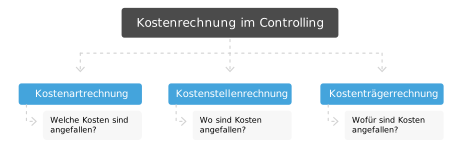
Cost center accounting forms the basis for the third part of cost accounting in the company, which is referred to as cost unit accounting. Only then can it be seen which costs were actually incurred and where. A cost object can be the production and sale of a specific product. As mentioned, there are individual costs that can be directly assigned to the product. If a specific circuit board is required for production, this cost item is quite easy to determine. But it is only with cost center accounting that costs that can be found elsewhere can be determined and can then be assigned to the cost object.
How is cost center accounting introduced and implemented?
The first step in introducing cost center accounting is to define cost centers. This process takes time and consists, on the one hand, of looking through all the documents in order to know what costs are or have been incurred.
On the other hand, the company must be sensibly divided into cost centers. This is where dividing according to functions or departments can be helpful. However, it is also conceivable to include a level that takes different locations into account, if this applies.
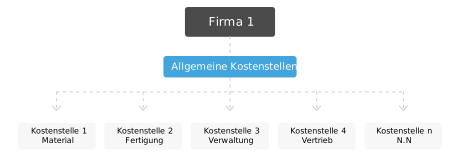
In accounting, the (overhead) costs incurred must then be assigned to the developed cost center system. In practice, a business accounting form is used as a basis. With its help, overhead costs are now broken down into the cost centers based on reference values.
That sounds complicated at first. In fact, the greatest effort in cost center accounting is the development of the cost center system and entering the cost centers into the accounting systems. Once the initial work has been completed, cost center accounting is simple in everyday life. Within document accounting, for example, incoming documents are then directly assigned a cost center or several cost centers, if applicable. The evaluation options then make it easier to compile reports.
Which conclusions are drawn from this is the responsibility of controlling.
What advantages does cost center accounting offer?
The big advantage of cost center accounting is the greater transparency for a company. This applies in particular, but not only, to the so-called overhead costs. Cost center accounting (or rather its evaluation) shows how expensive it actually is to produce a product. And it draws attention to particularly “expensive” business areas. It thus forms the basis for a whole range of analyzes and options for optimizing and improving processes and procedures.
Cost center accounting is also worthwhile in smaller companies
Probably only a few self-employed people will make the effort to introduce cost center accounting into their business. But it can already be useful: What costs were actually incurred in the context of a project? This is a question that can be answered using cost center accounting.
Setting up cost centers and the necessary discipline to take them into account when booking generate effort and therefore costs. However, this can be worthwhile even in smaller companies in order to recognize early on if economic difficulties are imminent.