Multichannel – a word that has been widely used by online retailers for years. But what does it really do? Jana Klingelhöfer, Content Manager at Billbee, explains. When she’s not filming a new How To video for Billbee’s YouTube channel, she takes care of the editorial freedom of the Billbee blog and website.
What does multichannel mean?
There are different models in the sales area: cross-channel approaches and single channel sales. In addition to multi-channel sales, the former include omni-channel sales and cross-channel sales.
Let’s start with the simplest business model: this Single channel sales. If you decide to do this, you will only serve one channel. That means you lead e.g. B. have your own online shop, but are not represented on marketplaces and do not have a brick-and-mortar retail store. The disadvantage here is obvious: you miss the chance to use the synergies of the different channels.
If you expand your single channel (e.g. your online shop) to include another, independent channel, this is called “Multichannel sales”. With multichannel, you run several channels next to each other, but independently of each other. A classic example of this is the online shop in combination with a brick-and-mortar store or your own online shop while you simultaneously sell your products on other platforms, such as. B. different marketplaces.
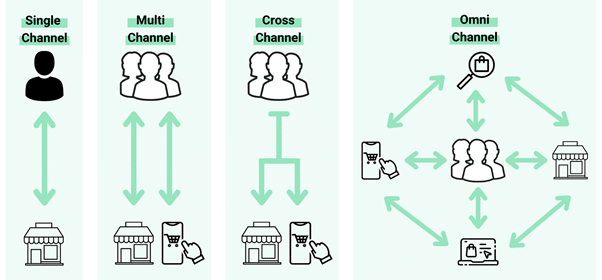
Other cross-channel sales models include cross-channel and omni-channel sales. At the Cross-channel sales The different channels support each other by breaking down barriers so that customers interact with you and your sales channels at different stages of the customer journey. This can result in your customers finding out about your products in one place but not buying there. An unpopular example of this is when customers go to a store to get advice and then buy online. Of course, it’s great if it’s your own online shop that’s part of the brick-and-mortar store where customers got advice. However, it can also happen that customers order online from a competitor. A more positive example of cross-channel sales is the “click and collect” principle, which has become particularly popular due to the corona pandemic. Your customer buys a product in your online shop and then picks it up in your store. The two sales channels are optimally linked to each other.
The most complex of the sales types mentioned is the Omni-channel sales, because your customers use multiple channels at once while shopping. An example of this is if you provide your customers with a tablet or smartphone while shopping in your brick-and-mortar store, on which they can access their customer data from your online shop and place their desired products in a virtual shopping cart Then pick up the item at the checkout after you have finished shopping and pay for it.
But back to multichannel:
Why can multichannel make you successful?
It is no longer a secret that multichannel sales and the associated sale of your products on multiple platforms and marketplaces are advantageous. But why do so many sellers rely on a multichannel approach?
#1 Larger target group
If you rely on just one stationary store with the single-channel strategy, then your possible target group is clearly defined and limited. Because it usually only includes people who live within a certain radius of your store. If you expand your sales activities to other channels (your own online shop or presence on one or more marketplaces), then you expand your target group with each channel. Take a look at the visit numbers for amazon.de: According to a study, in September 2021 amazon.de recorded around 477.5 million visits. Of course, they don’t all belong to your direct target group, but you will meet a lot of potential customers that you wouldn’t have reached with just a brick-and-mortar store.
#2 Higher sales figures
A larger target group also means larger sales figures. If you are only active on one channel, you are losing out on cash. Because if you are represented on one or more marketplaces in addition to your online shop, you improve the visibility of your company immensely, which can boost your sales figures.

#3 Be competitive
You can only be competitive if you are represented where your customers shop. It’s no use if you have a top-notch brick-and-mortar store, but your potential customers tend to shop online and your competitors are heavily represented there. Because then exactly what shouldn’t happen happens: people buy from your competitors. So a tip: Identify your competitors and analyze which channels they sell on! This gives you a good idea of which channels you could expand your sales activities to.
#4 Expand brand awareness
Big brands have shown the way: clothing and sporting goods manufacturers like puma orAdidas or hardware stores like Hornbach or Obi – What they all have in common is that customers have different channels as a contact point that they can use independently of each other. These are all companies that have become an integral part of Germany and are known to most people. Maybe your shop can’t (yet) compare to the size of these brands, but what works on a large scale can work just as well on a small scale!
#5 Risk mitigation
Setting up your own online shop or even a brick-and-mortar store requires a lot of resources. You invest time and money and don’t know whether the channel will be a success. So in this case, marketplaces might be a good start for you. Because on the whole, appearing on marketplaces is associated with a significantly lower financial risk than if you use resources to open a brick-and-mortar store or your own online shop - especially if you are still in the starting blocks with your online business -Business.
If you already have an online shop, then it can of course make just as much sense for you to expand your activities to marketplaces.
Three tips to get off to a successful start in multichannel
#1 Automation of workflows
Some things can make your everyday life easier – including automation! So why not use them to your advantage? When an order is received in your shop (or via a marketplace), then the real work begins. Preparing for shipping, creating a label, writing and sending invoices, sending shipping information and tracking links to the customer and much more Steps must be completed when placing an order. So that you don’t have to do everything by hand, you can use technology. Automations (usually through software) should be designed in such a way that they are tailored to your individual workflows and make your life easier, which ultimately leads to you saving time that you can then use for other things (e.g. marketing planning). can use.
All you have to do now is pack the ordered products into a box and tape it shut. Because if you don’t have a packing robot, this is one of the few tasks that automation can’t do for you - unless you outsource this process. This can be particularly useful if the scope is larger.
#2 create structures
The larger your online business becomes, the more essential it is that you create neat and well-thought-out structures. It is not without reason that many online retailers live by the motto “Time is money!” In the early days as an online retailer, you were probably able to manage everything well from home, and you may even have used your own garage as storage. But over time this is no longer enough. The first employees join and you invest more and more. But unfortunately the structures, order and process design often fall by the wayside. To ensure that this doesn’t happen and your work as an online retailer becomes overwhelming faster than you can imagine, you should regularly make time in your everyday life to bring order to your existing processes. Because a multichannel strategy can only be as good as the coordinated processing and control in the background.
#3 Keep an overview
Keep an overview - a tip that sounds banal, but is sometimes not easy to implement. The first thought when it comes to multichannel is often: “That’s a lot more effort, I don’t have any time for that.” But it does not have to be like this. The experience of some online retailers is that the effort increases with more sales channels. The beginnings are clear because, for example, you B. you only had to manage the item inventory on one channel and only had to keep the item information up to date on this one channel. Of course, due to the additional channels, this has to happen on every channel.
So that you and your online business don’t end up in chaos and everything gets over your head, you should get support in the form of a tool. This means you can keep track of everything in no time because all of your orders are then brought together in just one software and you can also update various information directly across channels, which helps to avoid unnecessary additional effort.
Such a tool can be, for example, Billbee. You can connect various shop systems and marketplaces to Billbee and handle all processes and tasks after the ordering process. From shipping the order to invoicing and automating workflows, you can easily set everything up yourself. You can find out whether Billbee is right for you with one 30-day free, non-binding trial period just try.

Jana is Content Manager at Billbee. When she’s not filming a new How To video for Billbee’s YouTube channel, she takes care of the editorial freedom of the Billbee blog and website.