The 2021 annual financial statements have to be done soon - and you still have no idea how? Read now what you as a startup founder need to pay attention to in the P&L and balance sheet.
Table of contents:
- Do I really have to prepare annual financial statements?
- What exactly do the annual financial statements contain?
- Is it worth preparing the annual financial statements yourself?
- Step by step to the annual financial statements – the checklist
- Prepare balance sheet and income statement
Have you just founded your startup, are building your team, fine-tuning product development – and now you also have to do the annual financial statements? For most startup founders, this is probably not an exciting task. Totally understandable, because you probably didn’t start your own business just to have to deal with taxes afterwards. Many entrepreneurs are therefore wondering whether they might be exempt from the obligation to prepare annual financial statements.
Do I really have to prepare annual financial statements?
Every company that is required to keep double-entry books must prepare annual financial statements. The obligation to prepare annual financial statements applies, among others, to these types of companies:
-
-
- GmbH
-
- KG
- OHG
- GbR
- UG
- AG
Therefore, you will most likely also be required to prepare annual financial statements. Only freelancers and sole proprietorships with an annual profit of less than 60,000 euros are exempt from the obligation.
What exactly do the annual financial statements contain?
With the annual financial statements, entrepreneurs gain a financial overview of the previous year. Of course, the annual financial statements are primarily prepared for the tax office. But the numbers are also quite informative for you as a startup founder. For example, conclusions and recommendations for action for the coming year can be derived from them. Therefore, annual financial statements make sense for your company!
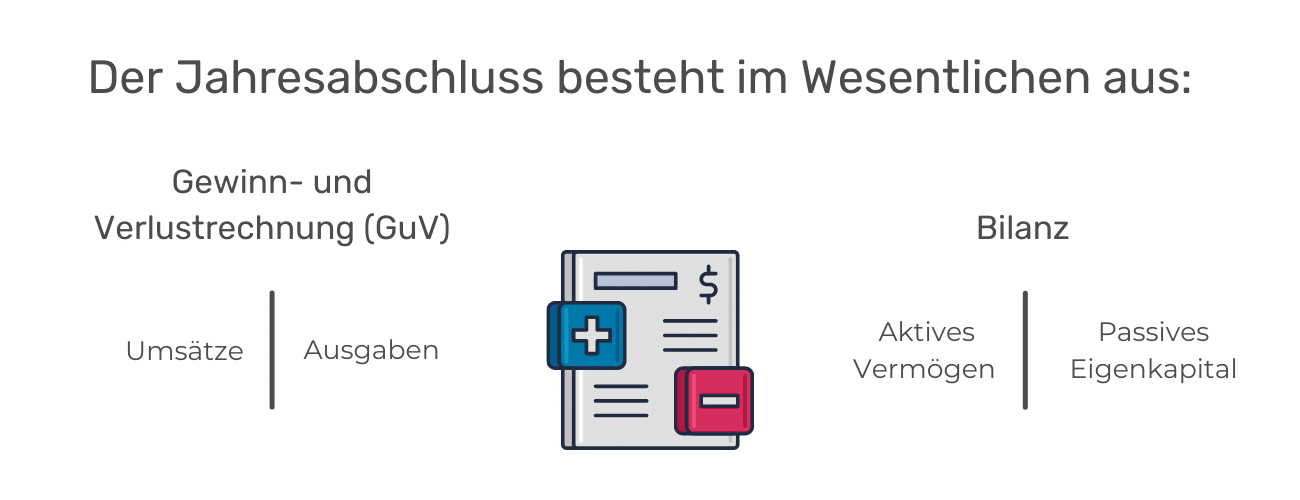
The heart of the annual financial statements is the profit and loss statement (P&L) and the balance sheet. With the P&L you compare your startup’s profit and loss over the past year. It is very similar on the balance sheet: Here you compare your “active” fixed and current assets with your “passive” equity.
Is it worth preparing the annual financial statements yourself?
Most well-known accounting tools, such as sevDesk or DATEV Mittelstand, “only” prepare the annual financial statements. Despite the software, you still have to have the annual financial statements and business evaluation (BWA) done by a tax advisor.
One of the few software solutions that completely handles the financial statements is Sage 50 Comfort. With the program, you can actually create the balance sheet yourself at the push of a button.
Step by step to the annual financial statements – the checklist
Still don’t really know what you need to consider when preparing your annual financial statements? Just check off this checklist step by step.
Check 1: Are all accounts closed?
An important first step: close all sub and main accounts from the past year. In many cases, individual items are posted in different sub-accounts for better clarity. Before the annual closing, you now merge all the bookings on the subaccounts back into the main account in order to then transfer them to the balance sheet.
Check 2: Do you have all receipts, documents and contracts to hand?
Ideally, you should carefully maintain your bookkeeping throughout the year. This means that every booking comes with a receipt. If you have followed this rule of thumb throughout 2021, all necessary documents such as invoices and contracts should already be in order for the annual financial statements.
If you spend more than an hour each month looking for receipts for your bookings, GetMyInvoices could be a noticeable relief for you. The software searches for all invoices from online portals and email inboxes for you. This means you no longer have to assign the receipts yourself, saving you a lot of time!

Check 3: Have you listed all of your assets?
In asset accounting you have probably already listed all assets such as land, office furniture, computers and vehicles. Check whether all items are listed and, if necessary, add any that are still missing.
Things get a little more complicated when listing current assets. To do this, you have to carry out a classic inventory. So, for example, if you run an online sportswear store, you now need to count all the clothing items you have.
Check 4: Have you recorded all depreciation?
The depreciation now results from the overview of the assets. These items lose value every year. This reduction in value is now determined as depreciation and thus reduces the company’s fixed assets. Attention: This means that depreciation directly affects your profit!
Additionally, check the condition of the listed items. If any are missing or in poor condition, you can write them off completely.
Check 5: Have you made provisions?
Also important for the balance sheet are provisions for future costs, the amount of which is still unknown. These could, for example, be future tax payments or legal costs.
Caution: These provisions may not be determined arbitrarily, but must be determined through a “reasonable commercial assessment” (Section 253 Paragraph 1 Sentence 2 HGB ). It is therefore best to save the calculation in case a company audit comes up.
Check 6: Have you listed all financial liabilities?
In addition to your inventory, current assets also include all outstanding invoices that have been issued to your customers. These are listed on the assets side of the balance sheet. However, the liabilities side of the balance sheet includes, for example, invoices for services and suppliers as well as for loans and other credit liabilities.
Check 7: Have you created prepaid expenses?
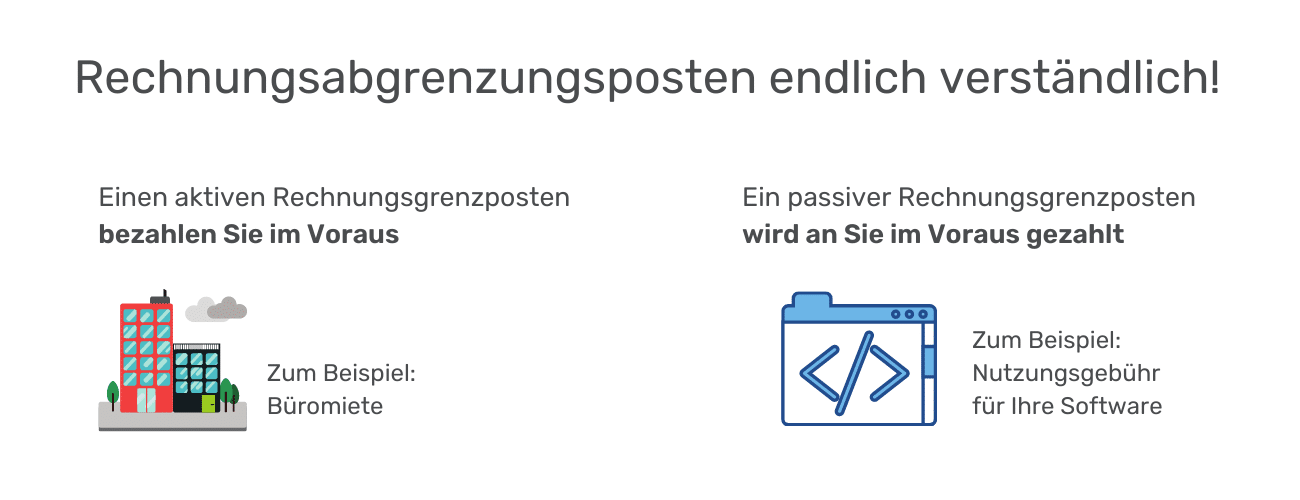
Invoices cannot always be clearly assigned to a financial year. For example, it may happen that an invoice was paid in 2021, but the service will not be provided until 2022. In these cases, a distinction is made between active and deferred income.
A active invoice limit item is a service that you paid in advance in 2021 for 2022. This could be, for example, a rent payment for your office space or an insurance premium for a year in advance.
A **passive invoice limit item ** is, however, an amount that you already received in 2021 for 2022 - a credit, so to speak. This could, for example, be the usage fee for your software for 2022 in advance, which your customer already paid in December 2021.
Prepare balance sheet and income statement {#“Bilanz}
With all of these lists, documents and information, you can now create your own balance sheet and profit and loss statement.
Profit and loss statement (P&L)
All income and expenses are compared in the income statement. In practice it can look like this:
| Should | Have |
|---|---|
| Rent for office | Sales |
| Personnel costs | Interest income |
| Steer | Other grants |
| Depreciation | – |
Balance sheet
On the balance sheet, you compare “assets” (assets) and “liabilities” (equity and debt). And like this:
| assets | liabilities |
|---|---|
| Capital assets | Equity capital |
| Current assets | Debt capital (e.g. loan) |
| – | accruals |
| Active prepaid expenses | Deferred income |
Do you have more questions?
The annual financial statements can be difficult to understand for entrepreneurs without business training. If you have further questions about the individual components of an annual financial statement, read on here: The most important components of the annual financial statements