Entrepreneurs who have to prepare a balance sheet for their business for the first time usually ask themselves what components it has and how it is structured correctly. Read here how you can create your balance sheet as an entrepreneur - including an example and template.
Table of contents:
- What is a balance sheet?
- Balance sheet obligation
- Prepare balance sheet
- Example balance sheet
- Free balance sheet template
- Manage accounting with GetMyInvoices
The most important answers to the topic of creating a balance sheet as an entrepreneur:
A balance sheet is a comparison of company assets and liabilities as of a reporting date. Together with the profit and loss statement (P&L), it forms the main part of an annual financial statement.
The following are subject to accounting:
- Sole proprietors with an annual turnover of more than 600,000 euros or a profit of over 60,000 euros
- Partnerships (OHG, KG)
- Corporations (GmbH, UG, GmbH & Co. KG)
- Public limited companies (AG)
Assets (asset side) include the assets of a company:
- Capital assets
- Current assets
- Active prepaid expenses
- Deferred tax assets
- Active difference from the asset statement
Liabilities (liabilities side) comprise the capital of a company. This includes:
- Equity capital
- accruals
- Debt capital
- Deferred income
- Deferred tax liabilities
There are different types of accounting:
- Opening balance
- Final balance
- Interim balance sheet
- trade balance
- Tax accounting
- Individual balance sheet
- Consolidated balance sheet
- Special balance sheet
When you hear the word balance sheet, do you first think of large corporations? However, it is also due at least once a financial year for smaller businesses. It is often a challenge, especially for young startups and sole proprietors who are required to report on their accounts. Because at the beginning they usually don’t know how accounting works and why it is needed.
What is a balance sheet used for?
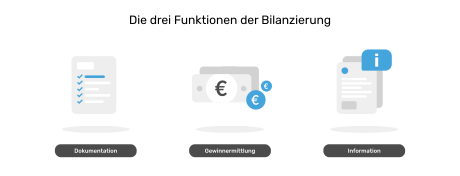
The balance sheet helps entrepreneurs to get an overview of the financial situation of their business as of a specific date. This is necessary in order to be able to make rational business decisions based on objective key figures. It is also important for the key figure-based assessment of the company’s development. A balance sheet therefore fulfills three basic functions :
- documentation
- Determination of profits
- information
Which companies are subject to accounting requirements?
Before you find out how a balance sheet is structured, you should check whether you are even required to report it. The general rule is that companies that are required to keep accounts have a balance sheet as part of their annual financial statements must show:
- Partnerships (OHG, KG)
- Corporations (GmbH, UG, GmbH & Co. KG)
- Public limited companies (AG)
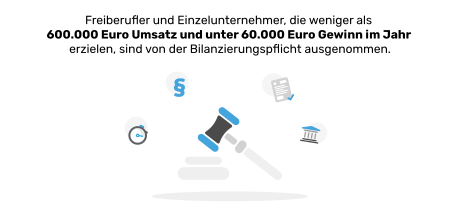
Freelancers and sole proprietors with a turnover of less than 600,000 euros generate a profit of less than 60,000 euros , however, are exempt from this obligation.
How to create your balance sheet
The legislature prescribes in the Commercial Code (HGB) how you should carry out your accounting and which structure must be taken into account. So you are not free in the form, but rather create the balance sheet according to a given scheme by comparing assets (asset side) and liabilities (liability side). This is a list of assets on the one hand and equity and debt capital on the other.
Important: The sum of the assets and liabilities sides must be identical (“equal balance sheet”).
assets
In the HGB under § 266 “Structure of the balance sheet” you will find the components and order of the assets page:
- Fixed assets: Intangible assets, tangible assets, financial assets
- Current assets: inventories, receivables and other assets, securities, cash on hand, federal bank balances, balances at credit institutions, checks
- Prepaid expenses
- Deferred tax assets
- Active difference from asset settlement
In brief: Assets represent your assets. On the assets side you show what you use your (financial) resources for.
liabilities
Just as for the assets, the list of items for the liabilities side can also be found under the same paragraph:
- Equity: subscribed capital, capital reserve, retained earnings, profit carried forward or loss carried forward, annual surplus or annual loss
- accruals
- liabilities
- Prepaid expenses
- Deferred tax liabilities
In short: Liabilities reflect equity and debt capital. On the liabilities side you indicate where your (financial) resources come from.
Theoretically, this setup is usually easy to understand. But what does a balance sheet look like in practice?
Example: This is what a balance sheet can look like
The fictitious company “ Mustermann GmbH ” prepares the following balance sheet as of December 31, 2021:
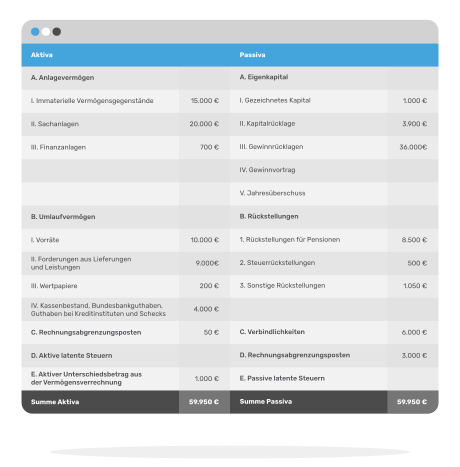
Example of a balance sheet
A notice: The principles of proper accounting must always be observed: balance sheet clarity, balance sheet truth, balance sheet identity and balance sheet continuity.
To create your balance sheet yourself, you can prepare your own Excel sheet or simply download our template.
Free download: “Balance sheet for entrepreneurs” template
Download the balance sheet template with just a few clicks. You can then easily individualize the pattern and adapt it to your business.

Free download: Balance sheet template:
In order to prepare your balance sheet quickly, professional accounting is essential. GetMyInvoices supports you in this.