Under certain conditions, freelancers and small businesses can choose whether to calculate their profit using the income surplus calculation. Read here what the EÜR includes, who can create one and what needs to be taken into account.
Table of contents:
- Determination of profits
- Determination of profits according to EÜR
- Create your own EÜR
- EÜR made easy with GetMyInvoices
Frequently asked questions on the subject of determining profits using the income statement:
To determine profit, compare your operating income with the operating expenses of a period. The result is your profit.
Excess income accounting is part of simple accounting. The profit and loss statement (P&L) as a sub-account of the balance sheet is part of double-entry bookkeeping and is much more complex.
To determine your profits, submit your tax return to the tax office together with the income surplus statement (Annex EÜR).
Nobody has to do an EÜR. Rather, you can opt for this simplified form of accounting under certain conditions. In principle, freelancers are allowed to submit an EÜR to the tax office. Traders whose annual turnover is less than 600,000 euros or whose annual profit is less than 60,000 euros can choose between EÜR and balance sheet.
Regardless of whether you are a freelancer, small business owner or self-employed - entrepreneurs have to prepare a profit calculation once a year. And the question arises as to which type of profit determination is suitable for you: balance sheet or income statement? If you do your bookkeeping yourself, you can quickly reach your limits. Even with the simplified form of the EÜR there are some special features to consider.
Determination of profits for freelancers and traders
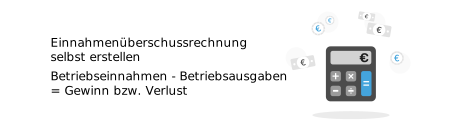
Freelancers and traders must determine their profits so that the tax office can tax them correctly. All business aspects are used to determine profits revenue of a financial year compared to the expenses. If your income was higher than your expenses, you made a profit. Conversely, there is a loss. The simple formula for determining profits is:
- revenue – expenditure = profit or loss.
Or to put it another way: Profit is what is left over at the end.
There are basically two ways of determining profits: The Balance sheet including the income statement and the income statement (EÜR). Which method you are allowed to use depends on various criteria.
EÜR or balance sheet: regulations for the method of determining profits
The balance sheet is much more complex than the EÜR and is mainly used by large companies. Therefore, most self-employed people and freelancers opt for the EÜR to determine their profits as long as they are not required to report on the balance sheet. After Section 4 Paragraph 3 EStG You are allowed to use the EÜR if the following criteria apply to you:
- Your professional activity is one of them Catalog professions according to Section 18 EStG .
- They introduce Small business .
- They are not registered in the commercial register.
- Your annual turnover is less than 600,000 euros.
- Your annual profit is less than 60,000 euros.
- If you are a farmer, the value of your usable area is a maximum of 25,000 euros.

Determination of profits using the income surplus calculation
As the name suggests, with the EÜR you compare your operating income with your operating expenses. The result of this is the surplus – your profit or your loss. This simple method of determining profits will also simple accounting called. To calculate, simply follow the tax office’s instructions: You will find one in your income tax return Excess income statement appendix (appendix EÜR) , which specifies the exact schema.
The inflow-outflow operation of the EÜR
In order to create an EÜR, it is first important to understand the calculation basis. The inflow-outflow principle, also known as actual taxation, states that all income and expenses within a year are included in the calculation. The decisive factor is the date on which the money moves.
For example, if you write an invoice in December 2022, but your customer doesn’t pay until January 25, 2023, the income belongs in the 2023 EÜR report.
Create your own EÜR
To determine your profit, you need a chronological overview of your income and expenses from the past year, including all receipts. If you are subject to VAT, you must also show the net amounts and VAT separately. Examples of income include:
- Net income from the sale of goods or services
- Tax refunds
- VAT collected
As a rule, you can consider all costs that were incurred for operational reasons as operating expenses. This means that the costs should be related to your business activities. Expenses include, but are not limited to:
- Expenses incurred for the sale of goods or services
- Wages and salaries
- Work equipment and software
- Telephone and internet costs
- VAT paid
- Rent for your business premises
- Traveling expenses
Good preparation is essential so that you don’t get lost in the chaos of papers at the end of the year and have to laboriously collect all the receipts. In the best case scenario, you document and archive all business income and expenses immediately after they arise. For example, you can use a simple Excel table to provide an overview. The only important thing is that you follow the guidelines of the GDPR. Because these say that the file must be unchangeable. Therefore, save the Excel table as a PDF at the end of the year - this is the only way you can submit it to the tax office.