If you eat out on business, you may be able to claim the costs against your taxes. But be careful: the tax office takes a close look at the entertainment receipt! You can find out when and how to claim business meals for tax purposes here.
Table of contents:
- Hospitality receipt: what is it?
- Fill out the hospitality receipt
- Free template
- Booking according to SKR 03
- Easily receive entertainment receipts with GetMyInvoices
The most important answers to the topic of filling out an entertainment receipt:
At a business meal, you can also claim tips as a business expense. Note the amount on the restaurant bill and then have it signed by the waiter.
When it comes to entertainment costs, a distinction is made between business entertainment for external business customers and company entertainment for internal employees. The costs of business entertainment are 100 percent deductible, while business entertainment costs are only 70 percent deductible.
As a general rule, you must fill out an entertainment receipt for every business meal. Entertainment receipts up to 150 euros are considered small-value invoices; if the amount is higher, you must add additional information to the receipt.
A meal together with partners and employees is simply part of stable business relationships. But the tax office often assumes that business meals are private pleasures: in the event of a tax audit, entertainment receipts are particularly often rejected.
In addition to the fact that many restaurant receipts do not even meet the legal requirements, there are even more tax flawed areas lurking when it comes to entertainment costs.
What is an entertainment receipt used for?
An entertainment receipt is used to document a business meal for the tax office. Because loud Section 4 Paragraph 4 of the Income Tax Act (EStG) Business or business-related entertainment can be deducted - as so-called entertainment costs.
The legislature again understands entertainment costs differently R 4.10 Income tax guidelines “Expenses for the consumption of food, drinks and other luxury foods”.
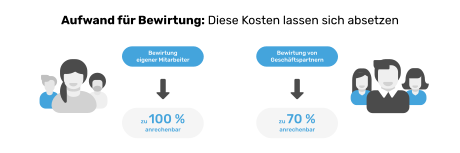
However, the amount you can deduct for entertainment costs depends on the reason for the entertainment. If you buy your employees – and their spouses – a meal, you can deduct 100 percent of the cost. A business meal with external business partners, on the other hand, is only 70 percent deductible if
- the entertainment is for a business occasion
- the costs are proportionate to the company’s profits
- You can prove the entertainment costs
For the latter you need the entertainment receipt. It serves as proof of your creation Cost and is included in the proper accounting. Because only those who can prove their costs can expect the tax office to credit them against their taxes.
The occasion is crucial!
Strictly speaking, entertainment costs only include business-related or business-related entertainment. A business occasion occurs when you entertain external business partners, for example:
- Potentially invite new customers
- Thank existing customers for the good business relationships
- Discuss planned projects with suppliers, consultants or customers
- Discuss the conclusion of a contract with business partners
If you invite your own employees, this is called company-sponsored entertainment. These are often:
- Company parties
- Employee training, lectures, project meetings
- anniversaries
You can deduct 100 percent of the costs up to twice a year, provided that the costs per employee and event do not exceed 110 euros (including VAT).

A notice: If business partners take part in your employee events, the entertainment costs are divided: You can estimate 70 percent for business partners and 100 percent for company employees. If employees attend the business meal, you can only deduct 70 percent of their costs from your taxes.
When do I need an entertainment receipt?
You must always include an entertainment receipt with your tax. In addition to the restaurant receipt itself, other information is crucial. The receipt alone does not show whether the meal was a work-related expense and with whom.
And for that you need the entertainment receipt! It is important that you fill this out correctly - because the tax office is watching like a hawk!
Fill out the entertainment receipt correctly: This is how it works
The requirements for an entertainment receipt are correspondingly high. But don’t worry, it’s usually very easy to create.
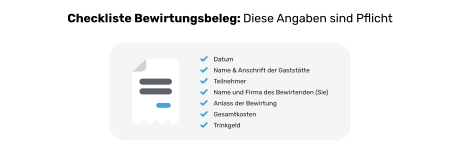
The mandatory information includes:
- Date and place of entertainment
- The names of all participants, including the host (you)
- The reason for the hospitality
- The total cost of the entertainment
- your signature
You can also deduct tips. To do this, simply write down the amount on the bill, have the waiter sign it again and note it later in the entertainment receipt.
Required information from the restaurant
In order for your meal to actually be deducted, the restaurant must also provide information. Because basically, restaurant receipts are nothing more than invoices. The mandatory information on the invoice includes:
- Name and address of the catering establishment
- Date of invoice
- Consecutive invoice number
- List of all food and drinks including prices
- The net invoice amount and the VAT rate
If the invoice amount is less than 250 euros, this is referred to as a small amount invoice. If your food exceeds this amount, you will be loud §14 Sales Tax Act (UStG) The following information is also required:
- Name and address of the host (i.e. you as the invoice recipient)
- Name and address of the restaurant
- Tax or VAT ID of the venue
Entertainment receipt template
Many restaurant receipts already have the entertainment receipt printed on the back as a suitable form. If not, you can use the free sample template from GetMyInvoices. Just fill this out and then enclose it with the invoice:

Book entertainment costs according to SKR 03: Here’s how it works
Once you have filled out the entertainment receipt correctly, the only question that remains is how to correctly record the costs. It is important that you book the business meal promptly and no later than 10 days after the meal.
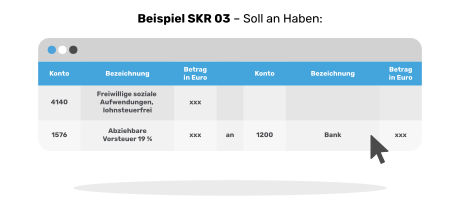
Post company entertainment costs (according to SKR 03)
The SKR 03 is a standard chart of accounts provided by DATEV. In practice, it has proven useful to always record employee entertainment under the “Voluntary social benefits, tax-free” account.
Book business entertainment costs (according to SKR 03)
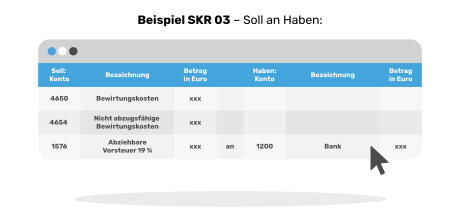
You remember: You can only charge 70 percent of meals with business partners. You book as follows: