**Do you have to keep double-entry bookkeeping and do you also have to prepare a profit and loss statement with your annual financial statements? Read here how a profit and loss statement is structured and which regulations apply - including an example, formula and template. **
Table of contents:
- Profit and loss statement: what is it?
- Construction
- Formula & Example
- Template
- Tax
- Easily create a profit and loss statement with GetMyInvoices
**The most frequently asked questions about the profit and loss statement at a glance: **
According to Section 242 III of the German Commercial Code (HGB), the profit and loss statement (P&L) belongs to the annual financial statements together with the balance sheet. Accordingly, all merchants who prepare annual financial statements and are obliged to keep double-entry books must also prepare a profit and loss statement.
The profit and loss account is a sub-account of the equity account and therefore part of the balance sheet. The P&L account is therefore on the liabilities side of the balance sheet.
Annual financial statements , Balance sheet , profit determination, gross profit, total costs: accounting can be confusing. But if you at least know the basics, you will benefit from many advantages. Finally, in some cases, annual financial statements, balance sheets and profit and loss accounts are not only mandatory. They also give you as a founder a detailed overview of the current situation financial position Of your company.
What is the profit and loss statement?
The profit and loss statement (P&L for short) presents everything expenditure and Yields of your company within an economic period. The purpose is to maintain an overview of your business activities and to determine your annual business profit or loss. If your income is greater than your expenses, you have made a profit - conversely, you make losses. Loud § 242 III HGB paragraph 3 “The balance sheet and the profit and loss account form the annual financial statements”. Accordingly, she is mandatory for all merchants , which are obliged to double-entry bookkeeping and must be prepared and reported at least once a year. Due to the high level of transparency, many entrepreneurs even decide to prepare the income statement on a monthly basis.

Structure and structure of the profit and loss statement
You have two different options for setting up your income statement: the account form and the staggered form.
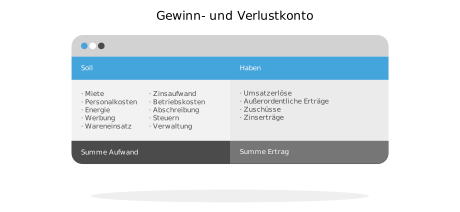
P&L structure in account form
The P&L in account form is structured like a conventional T-account with two columns (debit/credit), with expenses in the debit and income in the credit. Examples of income include sales revenue, grants and interest income. Costs can represent personnel costs, repairs, depreciation or use of goods. At the end of the economic period, the total of the income statement - like any other account - must be netted (balanced).
P&L structure in staggered form
If you use the staggered form, you must list all expenses and income in a list. It is best to follow the guidelines for the structure § 275 Para. 1 HGB . When it comes to the relay form, there are two variants that lead to the result.
The total cost method
The total cost method is in § 275 Para. 2 HGB described based on the individual positions. In the total cost method
- …the turnover of an accounting period is the basis for calculation.
- …all costs are compared to revenues.
- …the expenses are divided according to cost types (material costs, personnel costs, etc.).
- …the inventory is also taken into account: increases in inventory are included in income and decreases in inventory are included in expenses.
The cost of sales method
The cost of sales method and its structure are also in § 275 Para. 3 HGB set. In this procedure
- …the turnover of an accounting period is also the basis for calculation.
- …only the costs incurred for the goods and services sold are taken into account (cost of sales).
- …expenses are differentiated according to where they were incurred. For example, distribution costs are differentiated from warehousing costs.
Gross or net principle
Regardless of the form, you also have to distinguish whether you use the net or gross principle. Depending on the principle, you may or may not offset your income:
- Gross principle: It may not be offset - income and expenses are listed individually.
- Net principle: It can be offset - income and expenses are offset against each other.

Profit and loss statement explained simply: formula and example
The total cost and cost of sales method is best explained with a simple example.
Example and formula P&L – total cost method
Let’s say you produce clothing and 10,000 t-shirts are made. A T-shirt has a retail price of 30 euros and production costs of eight euros per item. You can sell 8,000 shirts directly, the remaining 2,000 shirts remain in stock in your warehouse. In addition, there are indirect costs of 6,000 euros for production, such as accounting and human resources costs. The formula of the total cost method is as follows:
|
Sales revenue: 240,000 euros (30 euros per shirt x 8,000 sales) |
| + Inventory increase 16,000 euros (eight euros x 2,000 shirts) |
| – Expense 86,000 euros (eight euros x 10,000 shirts + 6,000 euros) |
|
= Operating result (EBIT) 170,000 euros |
Example and formula P&L – cost of sales method
For the cost of sales method, the example is as follows:
|
Sales revenue: 240,000 euros (30 euros per shirt x 8,000 sales) |
| – Manufacturing costs of sales: 64,000 euros (eight euros x 8,000 shirts) |
| = Gross profit on sales: 176,000 |
|
– other expenses: 6,000 euros |
| = Operating result (EBIT): 170,000 euros |
Profit and loss statement template
To ensure that nothing goes wrong when creating your P&L, you can find a free P&L template to download here.

Profit and loss statement for tax
The legislature stands for the taxation The balance sheet is the focus of your company’s profits. But the income statement also provides important fundamentals. Finally, it shows all business activities of an economic period in detail. Thanks to it, the determination of profits within the framework of double-entry bookkeeping is really comprehensible. It is therefore important to prepare the income statement particularly carefully and to avoid errors.