What is double-entry bookkeeping, when does it have to be created and what advantages does it bring? Read all the basics of double-entry bookkeeping here.
Table of contents:
- What is double-entry accounting?
- Double-entry bookkeeping: when?
- This is how double work works
- Double entry bookkeeping example
- Advantages of double-entry bookkeeping
Frequently asked questions and answers about double-entry bookkeeping:
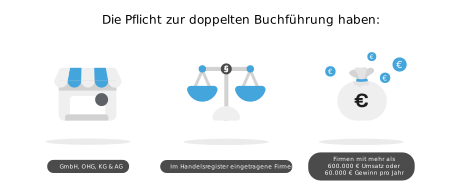
You are required to keep double-entry books if:
- You run a GmbH, GmbH & Co. KG, OHG, KG or AG.
- You are a merchant registered in the commercial register.
- Your annual turnover or annual profit is over 600,000 euros.
Double-entry bookkeeping records all business transactions twice. These are booked according to the basic principle of “debit to credit” in an account in “debit” and in a counter account in “credit” with the same amount in each case. You can find an illustrative example in this article.
The double-entry bookkeeping system may initially sound like double work. In fact, it is also more extensive than the income surplus calculation (EÜR). Nevertheless, double-entry bookkeeping has one key advantage: it provides a more complete picture of how money moves within your company. Thanks to it, you not only stay in control of your finances, but you can also make better financial decisions.
What is double-entry accounting?
With double-entry bookkeeping, also known as double-entry bookkeeping or “Doppik”, you systematically map all business transactions in your company. It is double because income and expenses are recorded twice. The recording takes place in accounting accounts – the so-called T-accounts. You record expenses in one account and income in a counter account.
Double-entry accounting forms the Basis for your profit and loss statement (P&L) , Her Balance sheet and your `s Annual financial statements . The Doppik also provides information about the profitability of your company within a period. There are two types of determination: the inventory comparison within the balance sheet and the comparison of income and expenses in the income statement.
Who does double-entry bookkeeping apply to?
Whether you are required to keep double-entry books depends on your annual turnover, your annual profit and the legal form you choose. The following criteria oblige you to keep double-entry books:
- They use the legal form GmbH , GmbH & Co. KG, OHG, KG or AG.
- They are registered in the commercial register.
- Your annual turnover is over 600,000 EUR or your annual profit is over 60,000 EUR.
- You run an agricultural business and the value of your usable space is over 25,000 euros.
Freelancers, self-employed people and Small business owner without an entry in the commercial register are therefore exempt from double-entry bookkeeping. An income surplus statement (EÜR) is sufficient to determine profits.
How to post business transactions using double-entry bookkeeping
If you spend or earn money in your company, you must record these business transactions in accounts. The credits on one account must balance the debits on another - this is the only way the system remains in balance. This method is based on the “debit to credit” booking logic. With this principle, all business transactions are recorded in the respective T-accounts. The T-accounts are shown so that the debit side is on the left and the credit side is on the right.
The accounts are divided into different levels and flow into the profit and loss statement (P&L) or the balance sheet:
|
First floor |
second level |
Third level |
|
Inventory accounts |
Active and passive account |
Balance sheet |
|
Success accounts |
Expense and income account |
P&L |
Inventory accounts are closed on the balance sheet as of the balance sheet date, while income accounts are closed on the income statement. And since the P&L account is only a sub-account of the equity account, the P&L is closed on the liabilities side of the balance sheet.
The basic rules of double-entry bookkeeping
Depending on which type of receipts and withdrawals you post to which account, there are some basic rules of double-entry accounting:
- Debit entries are always on the left side, credit entries are always on the right side.
- The following applies to active inventory accounts: Arrivals are posted as debits and disposals as credits.
- The following applies to passive inventory accounts: additions are posted as credits and disposals as debits.
- The following applies to the expense accounts in the income statement: Additions, i.e. expenses of any kind, are on the debit side and reductions on the credit side.
- The following applies to the income accounts in the income statement: Additions, i.e. income of any kind, are on the credit side and reductions are on the debit side.
Double-entry bookkeeping: an example
At the beginning of the year, there are 2,000 euros in your opening balance in the “Bank” asset account. To buy new goods, you also take out a loan of 8,000 euros.
The loan goes to the existing “bank” account (active account), which now contains a total of 10,000 euros. In addition, when you take out the loan, you debit your liability account (passive account) by 8,000 euros. On the liabilities side, the 2,000 euros in the bank account are already booked in the “equity” account (liabilities side) – debits and credits are in balance.
|
Balance sheet |
|
|
Should |
Have |
|
Bank 10,000 euros |
Liabilities 8,000 euros |
|
|
Equity 2,000 euros |
|
Total 10,000 euros |
Total 10,000 euros |
During the financial year you sell all goods at a profit. Your proceeds are 15,000 euros. You also record this business transaction according to the debit to credit principle, only this time in the income statement.
To do this, you first post the 10,000 euros to the “Purchase of goods” expense account (debit) and 15,000 euros (credit) to the “Sale of goods” income account. At the end of the year, you close the expense and income accounts via the income statement and balance the difference. If the balance is on the debit side, as in this example, then the expenses are less than the income and you have made a profit. Conversely, your company made losses in the financial year.
|
P&L |
|
|
Should |
Have |
|
Cost of goods sold 10,000 euros |
Sales revenue 15,000 euros |
|
Balance 5,000 euros |
|
|
Total 15,000 euros |
Total 15,000 euros |
You then enter the balance for your final balance sheet into the equity account - of course according to the debit to credit principle. At the same time, the 5,000 euros are visible in your bank account, so you also book the profit on the assets side of your balance sheet to the “Bank” existing account. Your final balance is balanced.
|
Balance sheet |
|
|
Should |
Have |
|
Bank 15,000 euros |
Liabilities 8,000 euros |
|
|
Equity 7,000 |
|
Total 10,000 euros |
Total 15,000 euros |
Advantages of double-entry bookkeeping
Even if you are not obliged to use Doppik, it offers many advantages for your company:
- You quickly uncover discrepancies because every business transaction is recorded twice.
- Complex business transactions are depicted in detail.
- They differentiate between expenses and income or expenses and income and thus reflect the company’s entire assets.
- It is clearer and enables more precise analyzes than simple accounting.
- It provides all the important information for potential lenders.